TRIR vs LTIFR: two safety rates, two bases

International: OSHA (United States), compared with the per-million-hours basis used in South Africa, Australia and ILO statistics.
A contractor is tendering for work with a US client. The tender form asks for its TRIR. The contractor's own monthly safety report shows an LTIFR of 4.0 and a TRIFR of 10.0. Neither number is the one the client asked for, and copying either into the form would be wrong. The two rates count different injuries, and they count them against different numbers of hours.
To work either rate out for your own site, use the free LTIFR and TRIFR calculator; it shows both bases side by side.
The two formulas
- TRIR (total recordable incident rate) = recordable cases × 200,000 ÷ hours worked
- LTIFR (lost-time injury frequency rate) = lost-time injuries × 1,000,000 ÷ hours worked
Two things change between them: the case definition on top of the fraction, and the basis that scales it.
Where 200,000 comes from
OSHA's injury and illness recordkeeping rule is 29 CFR Part 1904. OSHA gives the incidence rate formula as the number of injuries and illnesses multiplied by 200,000, divided by employee hours worked. In a 2016 letter of interpretation it explains the constant: 200,000 is the hours that 100 employees would work at 40 hours a week for 50 weeks a year. So a TRIR of 2.0 reads as "two recordable cases for every 100 full-time workers in a year".
What counts as "recordable" is set by 29 CFR 1904.7. A work-related injury or illness is recordable if it results in death, days away from work, restricted work or transfer to another job, medical treatment beyond first aid, or loss of consciousness, or if it is a significant injury or illness diagnosed by a physician or other licensed health care professional. First aid is a closed list in 1904.7(b)(5)(ii): if a treatment is not on that list, it is medical treatment.
Two details that change the number:
- OSHA's own pages call the all-cases figure the Total Case Rate. "TRIR" is the name most of industry uses for it.
- The Bureau of Labor Statistics method counts the nonfatal recordable cases from the OSHA Form 300A, and says hours worked should exclude paid time not worked, such as vacation, sick leave and holidays.
Where 1,000,000 comes from
The per-million basis is the international statistical convention. The resolution on occupational injury statistics adopted by the 16th International Conference of Labour Statisticians in 1998 defines the frequency rate as new cases divided by hours worked, multiplied by 1,000,000.
National practice follows it. Safe Work Australia publishes its frequency rates per million hours worked; the series it used to call LTIFR is now published as the workers' compensation injury frequency rate, and its "lost time claims" are claims with one day or shift or more away from work, a fatality or a permanent impairment. South Africa's Mine Health and Safety Inspectorate reports fatality and injury frequency rates per million hours worked in its annual report.
There is no single international definition of a lost-time injury. Some organisations count from the first full shift lost, some from the day after the injury, and some include restricted duty. Whatever yours is, write it down next to the rate.
A worked example
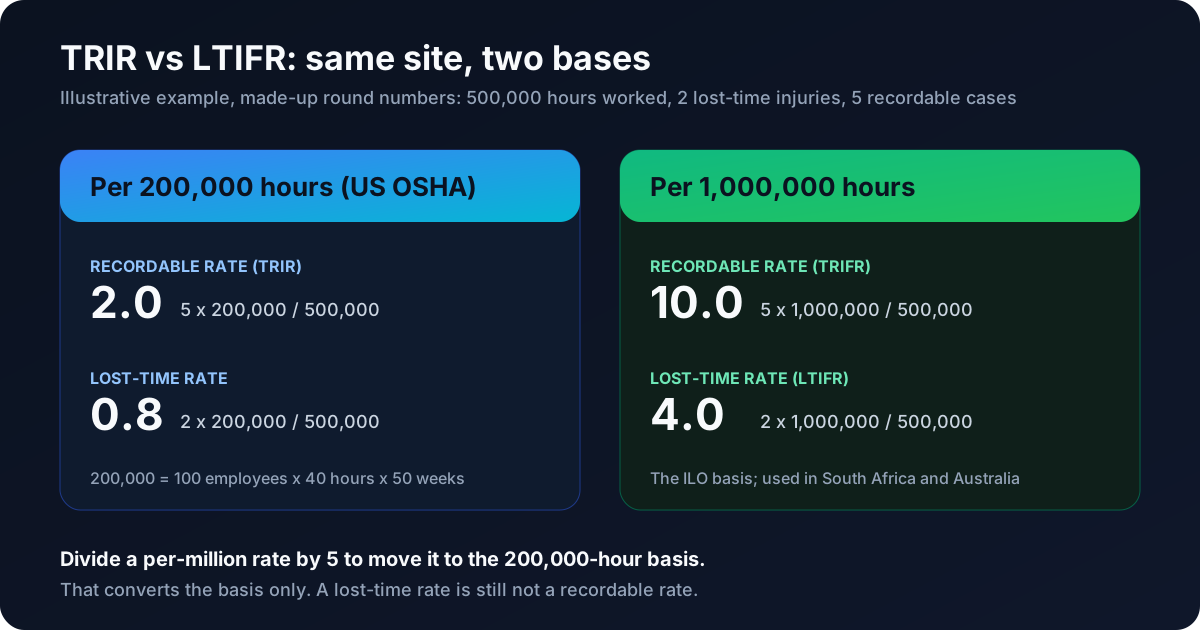
Illustrative example with made-up round numbers. One site, one year: 500,000 hours worked, 2 lost-time injuries and 3 other recordable cases (medical treatment and restricted work), so 5 recordable cases in total.
| Rate | Cases | Basis | Result |
|---|---|---|---|
| TRIR (OSHA) | 5 | 200,000 | 5 × 200,000 ÷ 500,000 = 2.0 |
| Lost-time rate, OSHA basis | 2 | 200,000 | 2 × 200,000 ÷ 500,000 = 0.8 |
| TRIFR | 5 | 1,000,000 | 5 × 1,000,000 ÷ 500,000 = 10.0 |
| LTIFR | 2 | 1,000,000 | 2 × 1,000,000 ÷ 500,000 = 4.0 |
The same five people were hurt. The four numbers range from 0.8 to 10.0.
Converting between the bases
A rate per 1,000,000 hours is five times the same rate per 200,000 hours. Divide by 5 to go from per-million to OSHA's basis; multiply by 5 to go the other way.
That converts the basis only. An LTIFR of 4.0 becomes 0.8 on the 200,000-hour basis, but it is still a lost-time rate. It is not a TRIR, because a TRIR also counts medical treatment, restricted work and the other recordable categories. To produce a TRIR you need the case count as OSHA defines it, not a converted LTIFR.
Our free LTIFR and TRIFR calculator works on either basis and shows the other alongside it.
What each rate hides
- Severity. A fracture and a sprain that needed a prescription are one case each. Neither rate tells you how badly anyone was hurt.
- Restricted duty. Under OSHA a restricted-work case is recordable, so it stays in the TRIR. Under many lost-time definitions it is not a lost-time injury. An LTIFR can fall because injured people were placed on restricted duty rather than because fewer people were hurt. Reporting both rates side by side makes that visible.
- Small denominators. OSHA's 2016 letter notes that one injury moves a small employer's rate far more than a large employer's, and suggests pooling three years of cases and hours. Safe Work Australia likewise suggests a longer period, such as five years, for smaller organisations.
- The hours. Contractors in or out, estimated or actual hours, paid leave included or excluded: each choice moves the rate without a single injury changing.
- Everything before the injury. Near misses, failed inspection items and actions that sit open for weeks never appear in either rate. OSHA's letter recommends using leading as well as lagging indicators for this reason.
Reporting both honestly
- State the basis in the label: "TRIR (per 200,000 hours)", "LTIFR (per 1,000,000 hours)".
- State the case definition, whether contractors are included, the period and where the hours came from.
- Never compare a rate on one basis with a benchmark on the other.
- When a client asks for TRIR, count recordable cases the way 29 CFR 1904.7 defines them.
Where Inspecable fits
Inspecable does not calculate your TRIR or LTIFR; the free calculator above does that. What Inspecable handles is the leading side the rates cannot see. Inspections run offline on Android at the workplace. A failed item raises a tracked issue with a severity and a due date on the spot. An action cannot close without a method, evidence and a signature, from someone other than the person it was assigned to. Every inspection carries a hash-chained history of its sign-offs and amendments that you can verify on demand, and a date range of completed inspections exports as one ZIP. See how corrective actions work.
This is a general guide, not legal advice.
Frequently asked questions
What is the difference between TRIR and LTIFR?
TRIR counts every OSHA-recordable case (days away, restricted work or transfer, medical treatment beyond first aid and the other 29 CFR 1904.7 criteria) per 200,000 hours worked. LTIFR counts only lost-time injuries per 1,000,000 hours worked. They differ in both the cases counted and the basis.
How do I convert LTIFR to the OSHA 200,000-hour basis?
Divide the per-million rate by 5. An LTIFR of 4.0 is 0.8 per 200,000 hours. That changes the basis only: the result is still a lost-time rate, not a TRIR, because TRIR also counts medical treatment and restricted work cases.
Is a restricted-duty case a lost-time injury?
Under OSHA a restricted-work case is recordable, so it counts in the TRIR. Whether it is a lost-time injury depends on the definition you use; many lost-time definitions exclude it. State your definition next to the rate so readers can compare like with like.
References
- [1]OSHA, 29 CFR Part 1904, Recording and Reporting Occupational Injuries and Illnesses: https://www.osha.gov/laws-regs/regulations/standardnumber/1904
- [2]OSHA, 29 CFR 1904.7, General recording criteria: https://www.osha.gov/laws-regs/regulations/standardnumber/1904/1904.7
- [3]OSHA letter of interpretation, 23 August 2016, on how the incidence rate formula is used: https://www.osha.gov/laws-regs/standardinterpretations/2016-08-23
- [4]OSHA, Establishment Specific Injury and Illness Data (incidence rate formula, Total Case Rate and DART rate): https://www.osha.gov/Establishment-Specific-Injury-and-Illness-Data
- [5]US Bureau of Labor Statistics, How to compute your firm's incidence rate for safety management: https://www.bls.gov/iif/overview/compute-nonfatal-incidence-rates.htm
- [6]ILO, Resolution concerning statistics of occupational injuries, 16th ICLS, 1998 (paragraph 19, frequency rate per 1,000,000 hours worked): https://webapps.ilo.org/ilostat-files/SSM/SSM8/E/ANNEX.html
- [7]Safe Work Australia, Understanding workers' compensation injury frequency rates: https://data.safeworkaustralia.gov.au/help-resources/understanding-workers-compensation-injury-frequency-rates
- [8]Mine Health and Safety Inspectorate (South Africa), Annual Report 2022/2023, section 4.2.1: https://pmg.org.za/files/MHSI_Annual_Report_2022-2023_pdf.pdf
Ready to Transform Your Mining Operations?
Run your inspections on a phone with no signal, and close every failed item with evidence and a signature.
About Inspecable Team
Safety, Inspection and Field Operations
We build safety, inspection and asset management software for mines, process plants and heavy industry, with inspections that run offline on Android.
Related Articles
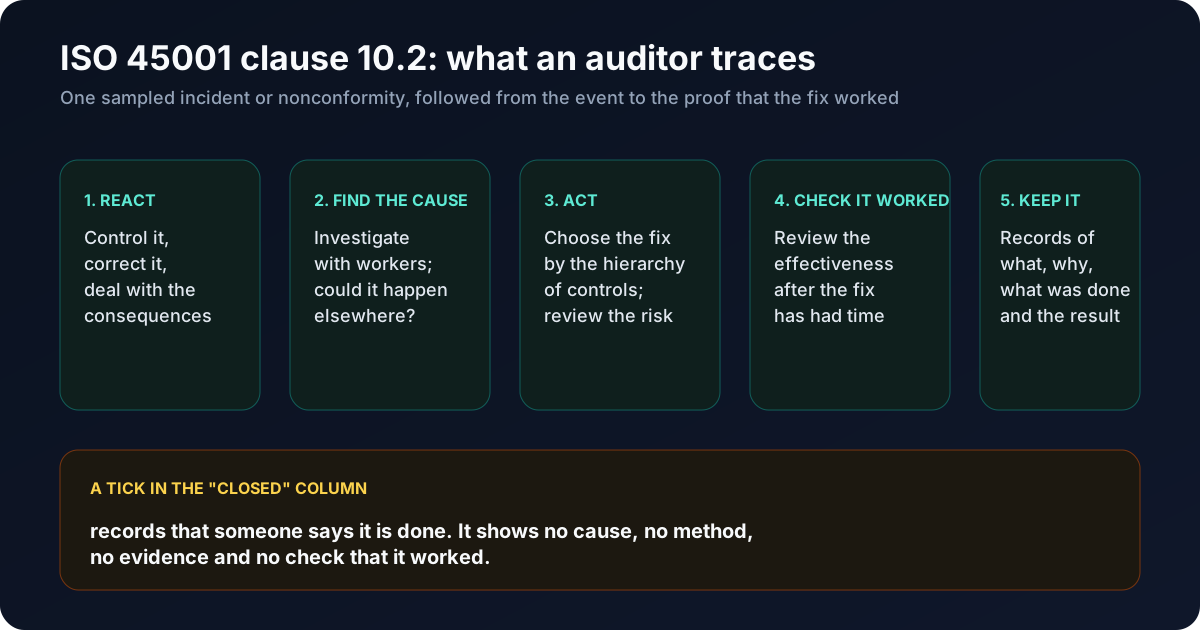
Corrective action under ISO 45001: what clause 10.2 asks you to prove
Clause 10.2 of ISO 45001 is not satisfied by a register full of ticks. An auditor samples actions and traces each one from the event to the cause, the fix and the proof that the fix worked. Here is what that trace looks for.
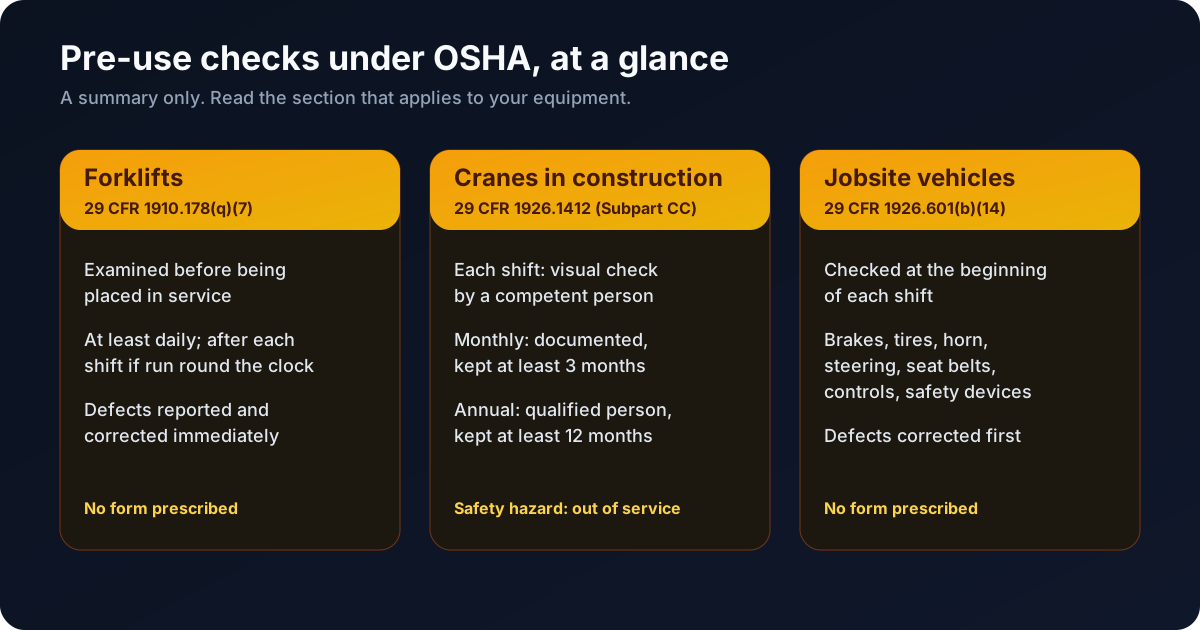
Pre-use inspections under OSHA: forklifts, cranes and mobile plant
OSHA requires forklifts to be examined before use, construction cranes to be inspected every shift, and jobsite vehicles to be checked at the start of each shift. It mostly does not say how to record it. Here is what the rules say and what a record that holds up contains.

The Hidden Cost of Paper-Based Mining Inspections
If you're a safety officer or operations manager in South Africa's mining sector still using paper inspection forms, paper is probably costing you more than you realize.