Pre-use inspections under OSHA: forklifts, cranes and mobile plant

International: OSHA (United States). This guide covers OSHA's general industry (29 CFR 1910) and construction (29 CFR 1926) standards. Mines in the United States are regulated by the Mine Safety and Health Administration (MSHA) under separate rules, which this guide does not cover.
At 06:00 a forklift is checked. A hydraulic hose is weeping. The form has one box for "OK" and one for "Not OK", the truck is needed for the first delivery, and the operator ticks "OK". At 10:00 the hose fails. Afterwards, everyone asks the same question: what did the check find, and what happened next? The form has a tick and an initial.
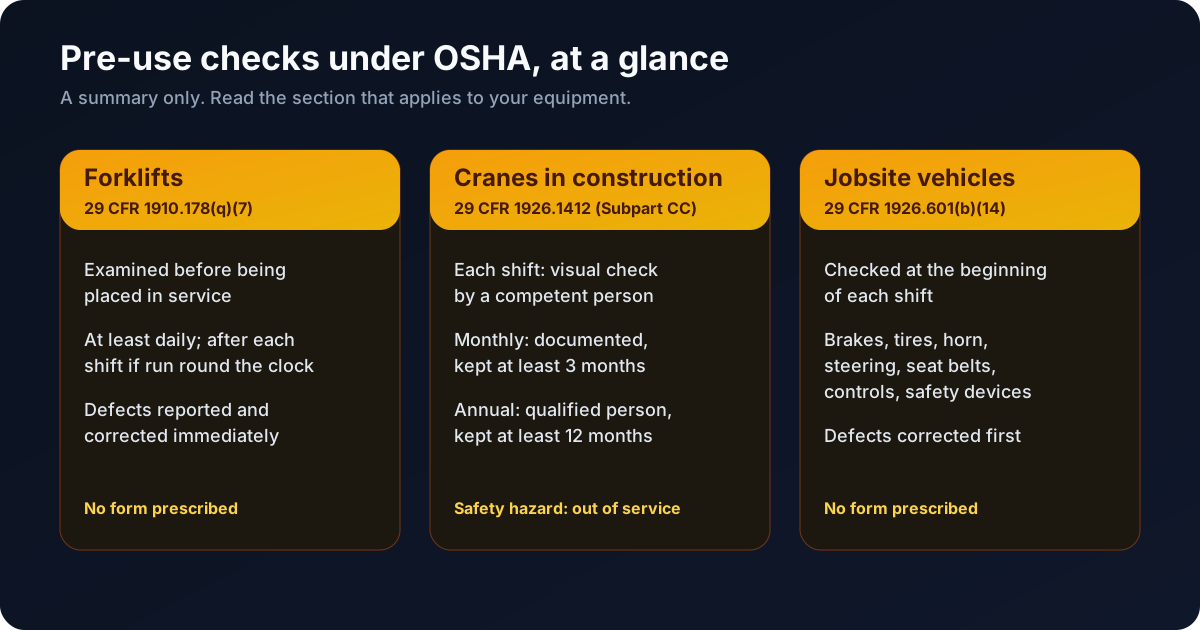
Forklifts: 29 CFR 1910.178(q)(7)
OSHA's powered industrial truck standard requires trucks to be examined before being placed in service. In summary, paragraph (q)(7) says:
- a truck must not be placed in service if the examination shows any condition that adversely affects its safety;
- the examination must be made at least daily;
- where trucks are used around the clock, they must be examined after each shift;
- defects must be reported and corrected immediately.
What (q)(7) does not do is prescribe a form or say how the examination is to be recorded. The duty is to examine; the record is how you show the examination happened, what it found and what was done about it.
Cranes in construction: 29 CFR 1926 Subpart CC
Subpart CC (Cranes and Derricks in Construction) sets out inspections in 1926.1412. At a high level:
- Shift inspection. A competent person begins a visual inspection before each shift the equipment will be used, and completes it before or during that shift. If a deficiency is found, the competent person decides at once whether it is a safety hazard; if it is, the equipment is taken out of service until it is corrected, subject to the limited exceptions the standard sets out.
- Monthly inspection. Each month the equipment is in service, it is inspected to the shift-inspection standard, and this one must be documented: the items checked, the results, and the inspector's name, signature and date. The record is kept for at least three months.
- Annual or comprehensive inspection. At least every 12 months a qualified person carries out a fuller inspection, including functional testing. It is documented in the same way and kept for at least 12 months.
In general industry, overhead and gantry cranes fall under 29 CFR 1910.179, which uses different terms: frequent inspections at daily to monthly intervals and periodic inspections at 1 to 12 month intervals. Monthly inspections of hooks, hoist chains and running ropes there call for a certification record with the date, the inspector's signature and an identifier for the item.
Jobsite vehicles and mobile plant: 29 CFR 1926.601
Section 1926.601 covers motor vehicles that operate within an off-highway jobsite not open to public traffic. Paragraph (b)(14) requires every vehicle in use to be checked at the beginning of each shift, so that the service brakes (including trailer brake connections), parking system, emergency stopping system, tires, horn, steering mechanism, coupling devices, seat belts, operating controls and safety devices are in safe operating condition and free of apparent damage. The same applies to lights, reflectors, windshield wipers, defrosters and fire extinguishers where they are needed. All defects must be corrected before the vehicle is placed in service.
Earthmoving equipment such as scrapers, loaders, bulldozers, graders and off-highway trucks falls under 1926.602 instead, which has no shift-start check written the same way. The manufacturer's instructions and your own inspection programme fill that gap.
What a defensible pre-use record contains
None of these three sections hands you a form, so the record is yours to design. One that holds up when someone asks questions afterwards contains:
- The machine. A unique identifier (fleet number or serial) and the hour meter or odometer reading.
- The person. Who did the check, and for cranes, that they are the competent or qualified person the standard requires.
- The time. Date, time and shift, recorded when the check was done, before the machine was used.
- Each item. Pass, fail or not applicable, against a checklist for that type of machine rather than a generic one.
- Evidence for every fail. What was wrong, in words, with a photo.
- The decision. Fit for service or not. If not, the machine is tagged out.
- Who was told. The supervisor or maintenance contact the defect was reported to.
- The repair. What was done, by whom, and who returned the machine to service and when.
- A signature. From the person who did the check.
- Retention. At least the periods the standard sets where it sets one (three months for monthly crane inspections, 12 months for annual ones), and your own written period where it does not.
Where records usually fail
- One tick for "all OK" instead of an answer per item.
- Checks filled in at the end of the shift, or for the whole week at once.
- A defect written down while the machine kept working, with nothing linking the defect to a repair.
- A generic checklist that does not match the machine.
- Paper that stays in the cab and never reaches anyone who could act on it.
Where Inspecable fits
With Inspecable the operator runs your own pre-use checklist on an Android phone or tablet, offline, at the machine. A failed item raises a tracked issue with a severity and a due date on the spot, so the defect is on the record the moment it is found rather than in a cab. The action that fixes it cannot close without a method, evidence and a signature, from someone other than the person it was assigned to. Every inspection carries a hash-chained history of its sign-offs and amendments that you can verify on demand, and a date range of completed inspections exports as one ZIP. See pre-start checks, or start from our forklift pre-use checklist, heavy equipment pre-start checklist or construction equipment pre-start checklist, and add your manufacturer's checks.
This is a general guide, not legal advice.
Frequently asked questions
How often must a forklift be inspected under OSHA?
Under 29 CFR 1910.178(q)(7) a powered industrial truck must be examined before being placed in service, at least daily, and after each shift where trucks are used around the clock. Defects must be reported and corrected immediately.
Does OSHA require a written forklift pre-use checklist?
Paragraph (q)(7) requires the examination but does not prescribe a form or say how to record it. Many employers keep a written or digital record because it is the only way to show the check happened, what it found and what was done.
How long must crane inspection records be kept in construction?
Under 29 CFR 1926.1412, the documented monthly inspection must be kept for at least three months and the annual or comprehensive inspection for at least 12 months. Each record names the items checked, the results, and the inspector's name, signature and date.
References
- [1]OSHA, 29 CFR 1910.178, Powered industrial trucks (paragraph (q)(7)): https://www.osha.gov/laws-regs/regulations/standardnumber/1910/1910.178
- [2]OSHA, 29 CFR 1926.1412, Inspections (Cranes and Derricks in Construction, Subpart CC): https://www.osha.gov/laws-regs/regulations/standardnumber/1926/1926.1412
- [3]OSHA, 29 CFR 1910.179, Overhead and gantry cranes (paragraph (j), inspection): https://www.osha.gov/laws-regs/regulations/standardnumber/1910/1910.179
- [4]OSHA, 29 CFR 1926.601, Motor vehicles (paragraph (b)(14)): https://www.osha.gov/laws-regs/regulations/standardnumber/1926/1926.601
- [5]OSHA, 29 CFR 1926.602, Material handling equipment: https://www.osha.gov/laws-regs/regulations/standardnumber/1926/1926.602
- [6]Mine Safety and Health Administration, Mission: https://www.msha.gov/about/mission
Ready to Transform Your Mining Operations?
Run your inspections on a phone with no signal, and close every failed item with evidence and a signature.
About Inspecable Team
Safety, Inspection and Field Operations
We build safety, inspection and asset management software for mines, process plants and heavy industry, with inspections that run offline on Android.
Related Articles
TRIR vs LTIFR: two safety rates, two bases
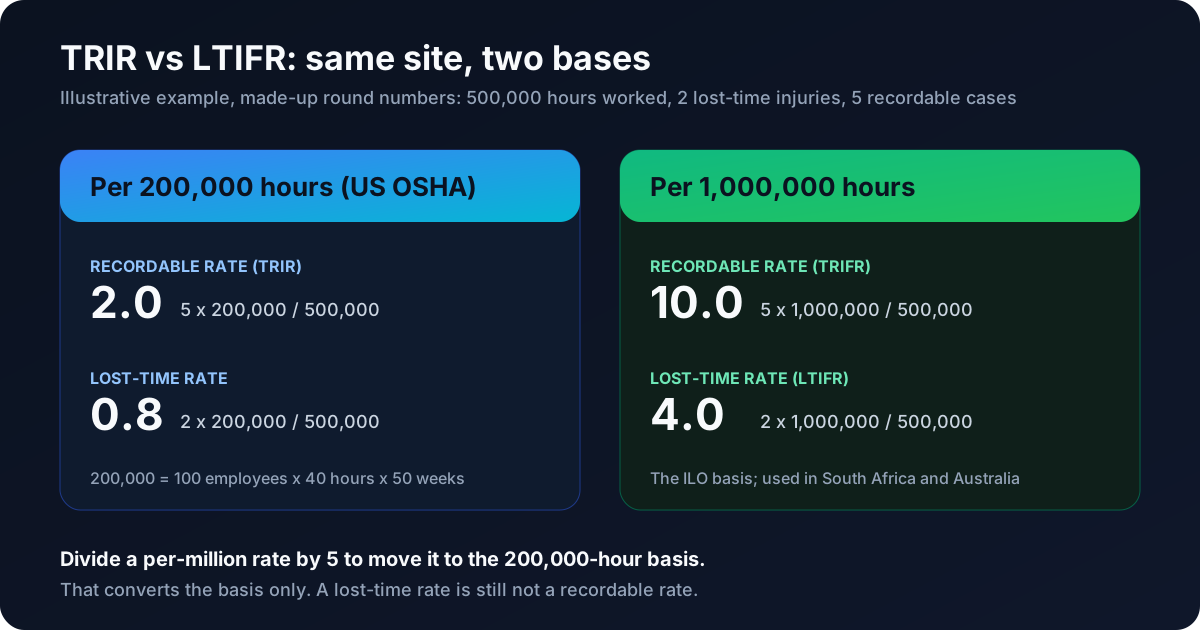
TRIR counts every OSHA-recordable case per 200,000 hours worked. LTIFR counts lost-time injuries per 1,000,000 hours. Same site, same year, very different numbers. Here is how each is built, how to convert between them, and what neither one shows.
Corrective action under ISO 45001: what clause 10.2 asks you to prove
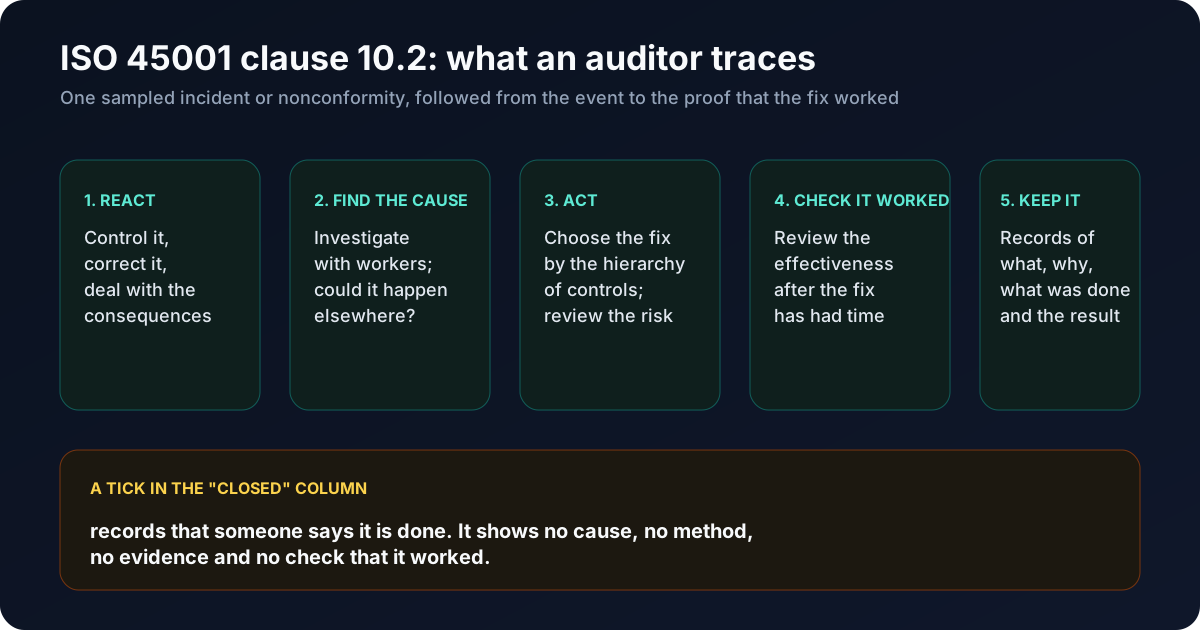
Clause 10.2 of ISO 45001 is not satisfied by a register full of ticks. An auditor samples actions and traces each one from the event to the cause, the fix and the proof that the fix worked. Here is what that trace looks for.
Offline-First vs Cloud Inspection Software for Mining
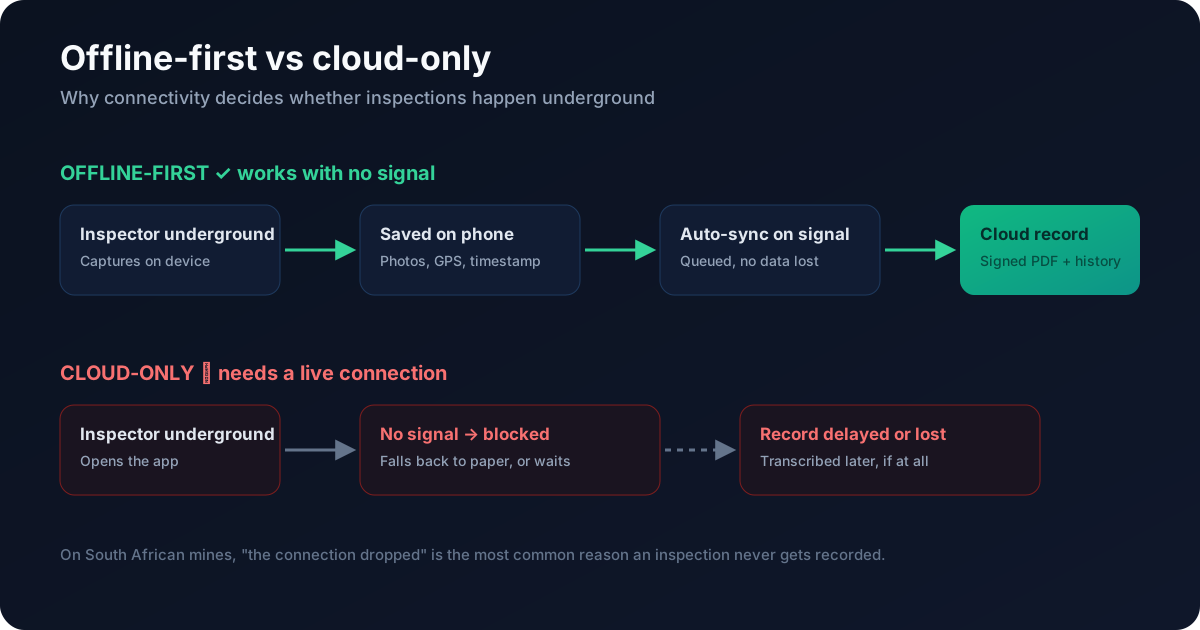
Cloud-only apps need a live connection — the first thing to fail underground. Offline-first apps capture on-device and sync later. Here is why that difference decides whether inspections happen at all.