Baseline vs Issue-Based vs Continuous HIRA: The Three-Tier Model

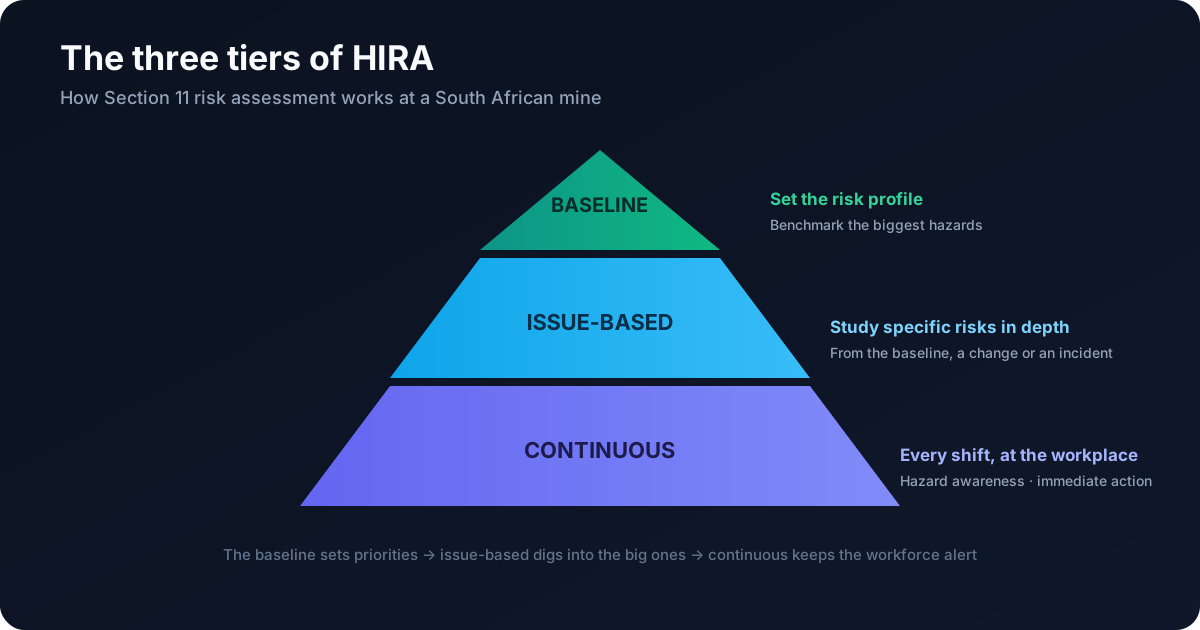
South African mining recognises three complementary types of hazard identification and risk assessment (HIRA): baseline (which sets the mine's overall risk profile), issue-based (which studies a specific process or high-priority risk in depth), and continuous (which happens every shift at the workplace). A compliant operation runs all three, and each one feeds the next. Together they satisfy the Section 11 duty to assess and respond to risk under the Mine Health and Safety Act.
What is a baseline risk assessment?
A baseline HIRA establishes a risk profile — a benchmark of the types and size of the hazards that could significantly affect the whole operation. You conduct it to understand where your biggest risks are, and then use it to prioritise which risks deserve deeper, issue-based study. Think of it as the map: it does not fix anything on its own, but nothing else is properly prioritised without it. The baseline is reviewed periodically as the operation changes.
What is an issue-based risk assessment?
An issue-based HIRA takes a specific risk, process, or change flagged by the baseline (or by an incident) and studies it in depth. Its output is clear recommendations to management for further action — this is the assessment that produces the corrective and improvement actions referenced in Section 11(2) of the MHSA. Issue-based assessments are triggered by:
- a high-priority risk identified in the baseline;
- a change to plant, process, layout or method; or
- an incident, near-miss or new hazard.
What is a continuous risk assessment?
A continuous risk assessment happens on an ongoing basis in the work environment — every shift, as an integral part of day-to-day management. The emphasis is on hazard awareness and immediate risk treatment: the mini-risk-assessment a team does before a task, the pre-use check, the "take-5". It is the tier most exposed to failure, because it happens constantly and is easiest to do on paper and never capture.
How do the three tiers work together?
| Tier | Sets / produces | Frequency | Feeds |
|---|---|---|---|
| Baseline | The mine's risk profile | Periodic | Priorities for issue-based |
| Issue-based | Recommendations to management | On trigger | Controls & procedures |
| Continuous | Day-to-day hazard treatment | Every shift | New issues back to the baseline |
The flow is a loop: the baseline prioritises the issue-based work, issue-based produces controls and safe procedures, and continuous assessment keeps the workforce alert and surfaces new hazards that feed back into the baseline.
Warning: the most common HIRA failure is not a missing baseline — it is thousands of continuous assessments done on paper that never became data, so trends are invisible and the same hazards recur.
Digitising the three tiers
Inspecable captures all three tiers in one place: baseline and issue-based assessments as structured, versioned records, and continuous risk assessments on a mobile app that works offline underground. Because every assessment and finding is data — not paper — recurring hazards become visible and issue-based recommendations become tracked corrective actions that actually close. For the legal context, see Section 11 of the MHSA explained and our complete MHSA compliance guide.
Frequently asked questions
What is the difference between baseline, issue-based and continuous HIRA?
A baseline HIRA establishes the mine's overall risk profile and priorities. An issue-based HIRA studies a specific high-priority risk or change in depth and produces recommendations to management. A continuous risk assessment happens every shift at the workplace, focused on day-to-day hazard awareness and immediate treatment.
Which type of risk assessment does the MHSA require?
The MHSA framework expects all three. The baseline sets priorities, issue-based assessments produce the recommendations referenced in Section 11(2), and continuous assessment keeps hazard control going day to day.
What triggers an issue-based risk assessment?
A high-priority risk flagged by the baseline, a change to plant, process or method, or an incident or near-miss.
References
- [1]Mine Health and Safety Act 29 of 1996, section 11 — SAFLII: https://www.saflii.org/za/legis/consol_act/mhasa1996192/
- [2]Different types of risk assessments — Labour Guide South Africa: https://labourguide.co.za/health-and-safety/different-types-of-risk-assessments
Ready to Transform Your Mining Operations?
Run your inspections on a phone with no signal, and close every failed item with evidence and a signature.
About Inspecable Team
Mining Safety & Compliance Specialists
We help South African mines and process plants run inspections offline on Android, turn every failed item into a tracked action with an owner and a due date, and close actions only with a method, evidence and a signature.
Related Articles
The Complete Guide to MHSA Compliance for South African Mines
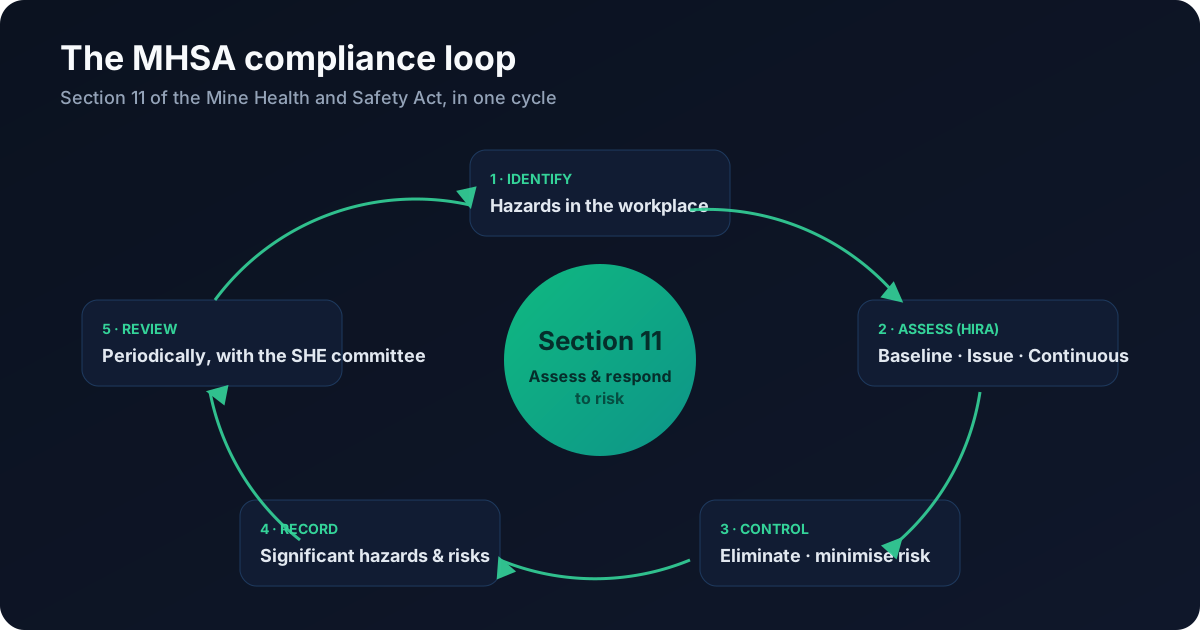
MHSA compliance comes down to a repeatable loop: identify hazards, assess the risk, control it, record it, and review. Here is how each part works — and how to keep the paperwork ready for an inspector.
Section 11 of the MHSA Explained: Your Risk-Assessment Obligations
Section 11 is the legal heart of MHSA compliance. It tells every employer to identify hazards, assess the risk, record it, control it and review it. Here is what each duty means in practice.
How to Prepare for a Mine Health and Safety Inspectorate Audit (what most people still call a DMRE audit)
An inspector will ask for your risk assessments, records, appointments and evidence that findings were closed. Here is the checklist to have ready — and how to make audit-readiness a by-product of daily work.