How to Prepare for a Mine Health and Safety Inspectorate Audit (what most people still call a DMRE audit)

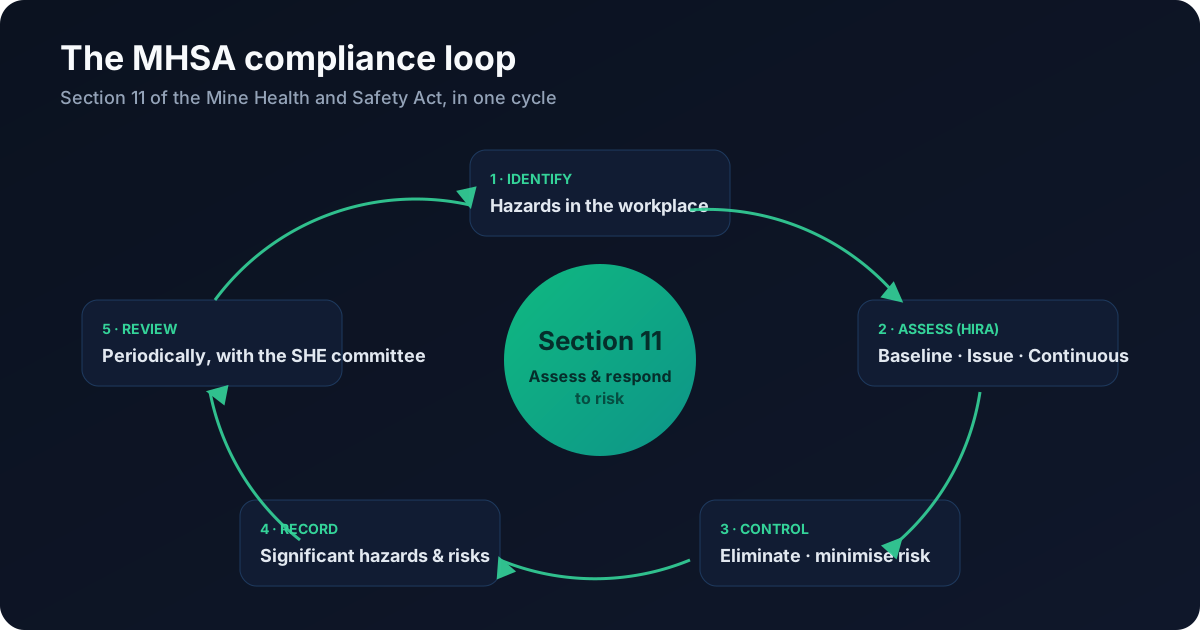
To prepare for a Mine Health and Safety Inspectorate audit (what most people still call a DMRE audit), have five things ready and current: your risk assessments (baseline, issue-based and continuous), evidence that the controls you chose were implemented and reviewed, your legal appointments and competency records, a clear trail showing findings were closed out, and your incident and inspection records — all produced quickly on request. The mines that pass smoothly are not the ones that scramble the week before; they are the ones for whom audit-readiness is simply the by-product of running the compliance loop every day.
This checklist covers what to prepare, the gaps that most often cause findings, and how to make the whole thing routine.
Who audits South African mines?
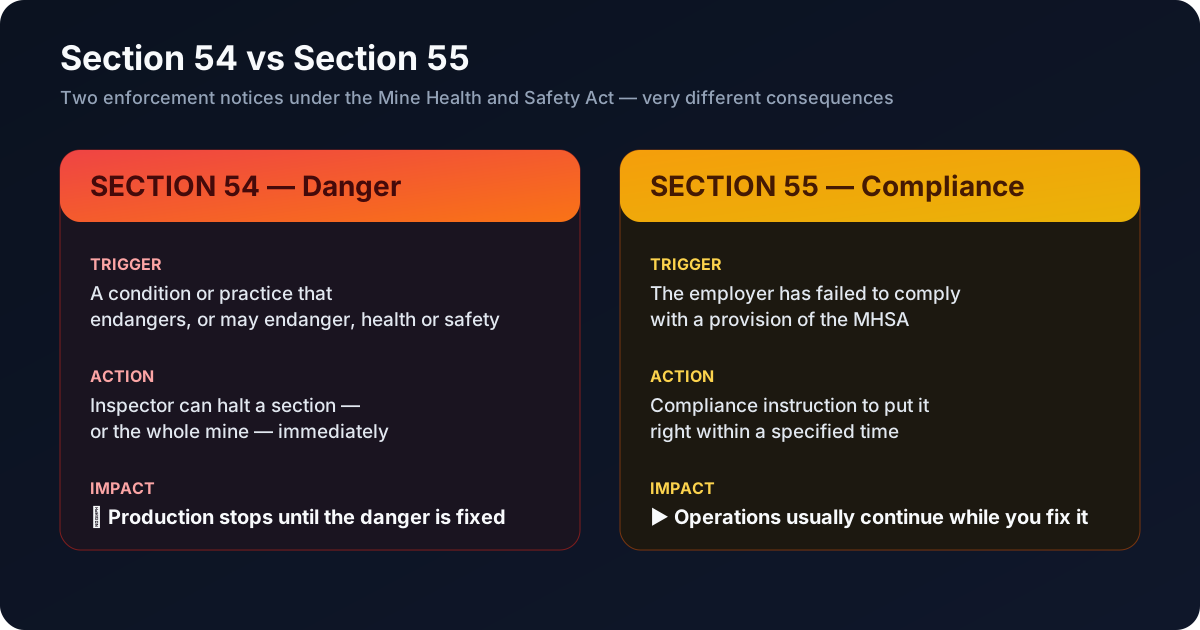
Mine health and safety is enforced by inspectors from the mining regulator (the Mine Health and Safety Inspectorate, which sits in the Department of Mineral and Petroleum Resources, the DMPR). They can inspect, request records, and issue Section 54 or Section 55 notices where they find danger or non-compliance.
The audit-readiness checklist
Risk assessments
- Current baseline risk assessment, with review dates.
- Issue-based assessments for high-priority risks and recent changes.
- Evidence that continuous risk assessment is happening at the workplace.
Controls and their evidence
- The controls chosen for significant risks, in the correct hierarchy (eliminate → control → minimise → PPE).
- Proof the controls were actually implemented — not just written down.
- Records of periodic review, including occupational-hygiene and medical-surveillance data.
People and appointments
- Legal appointments in place and up to date.
- Competency, certification and licence records for safety-critical roles — none expired.
- Health and safety committee consultation records.
The corrective-action trail
- Every significant finding linked to a corrective action with an owner and due date.
- Evidence that actions were completed and verified — the "loop closure" history.
Incidents and inspections
- Incident and near-miss records, investigations and outcomes.
- Inspection history you can filter by area, asset, date or inspector.
What causes the most audit findings?
Reality: most findings are not "you never did a risk assessment." They are "you cannot produce it," "the certificate expired," or "the finding was raised months ago and never closed." Every one of those is a records-and-follow-through problem, not a knowledge problem.
How to be ready for an audit all year
- Capture at the source — inspections and HIRA on a mobile device with photos and timestamps, not paper transcribed later.
- Close the loop — turn findings into tracked corrective actions so nothing ages silently.
- Watch expiries — check competencies and certificates against their expiry dates every month, so none lapses unnoticed.
- Make records searchable — produce "the risk assessment for that section" in seconds.
How Inspecable makes audits routine
Inspecable is built for this routine: inspections that run offline on Android with photo evidence and a signature on each step, every failed item becoming a tracked action with an owner and a due date, closure that needs a method, evidence and a signature, and a date-range ZIP export with an index spreadsheet and each signed PDF. Read the complete MHSA compliance guide for the framework, or book a demo to see it against your operation.
Frequently asked questions
What records does a Mine Health and Safety Inspectorate audit check?
Typically your baseline, issue-based and continuous risk assessments; evidence that controls were implemented and reviewed; legal appointments and competency records; the corrective-action trail showing findings were closed; and incident and inspection records — all produced quickly on request.
What causes the most findings in a mine safety audit?
Usually records problems rather than knowledge gaps: not being able to produce a risk assessment, expired competencies or certificates, and findings that were raised but never closed out.
How do you stay ready for an audit all year?
Capture inspections and HIRA digitally at the source with photo evidence, turn every finding into a tracked corrective action, check competency expiry dates every month, and keep records searchable so anything can be produced in seconds.
References
- [1]Mine Health and Safety Act 29 of 1996 — SAFLII: https://www.saflii.org/za/legis/consol_act/mhasa1996192/
- [2]Mine Health and Safety Council (MHSC): https://www.mhsc.org.za/
Ready to Transform Your Mining Operations?
Run your inspections on a phone with no signal, and close every failed item with evidence and a signature.
About Inspecable Team
Mining Safety & Compliance Specialists
We help South African mines and process plants run inspections offline on Android, turn every failed item into a tracked action with an owner and a due date, and close actions only with a method, evidence and a signature.
Related Articles
The Complete Guide to MHSA Compliance for South African Mines
MHSA compliance comes down to a repeatable loop: identify hazards, assess the risk, control it, record it, and review. Here is how each part works — and how to keep the paperwork ready for an inspector.
Section 54 vs Section 55 Notices Explained (and How to Avoid Them)
Section 54 responds to danger and can stop your mine. Section 55 responds to non-compliance and gives you time to fix it. Here is exactly how they differ — and how to avoid both.
Baseline vs Issue-Based vs Continuous HIRA: The Three-Tier Model
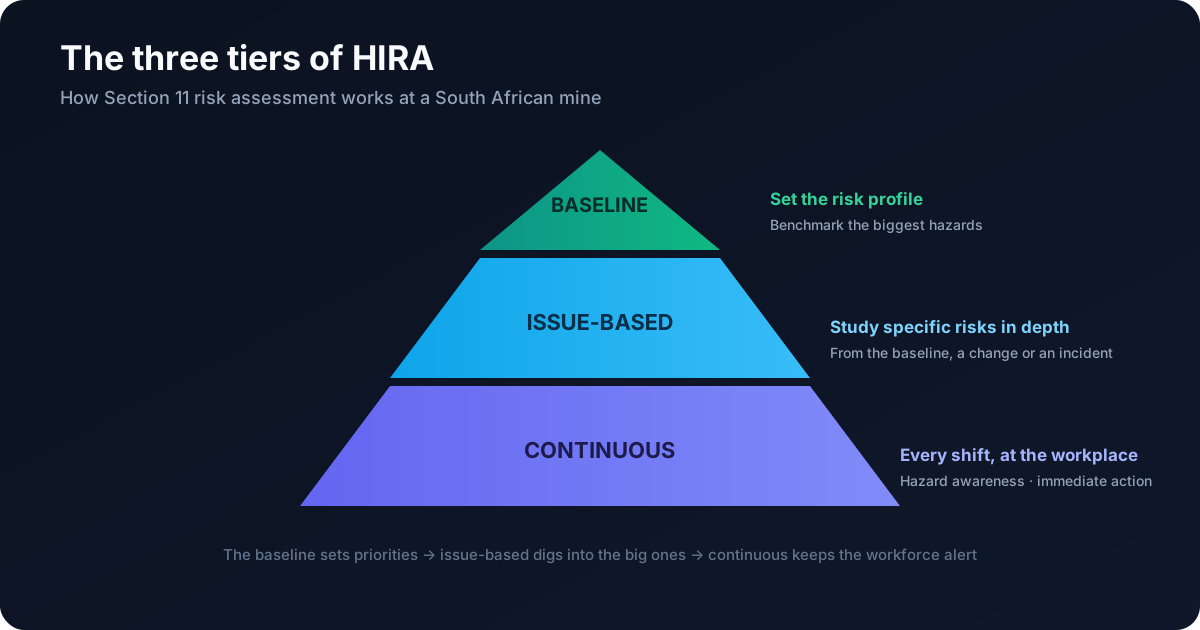
A compliant mine runs three kinds of HIRA. The baseline sets the risk profile, issue-based digs into the big risks, and continuous keeps the workforce alert every shift. Here is how they fit together.