The Complete Guide to MHSA Compliance for South African Mines

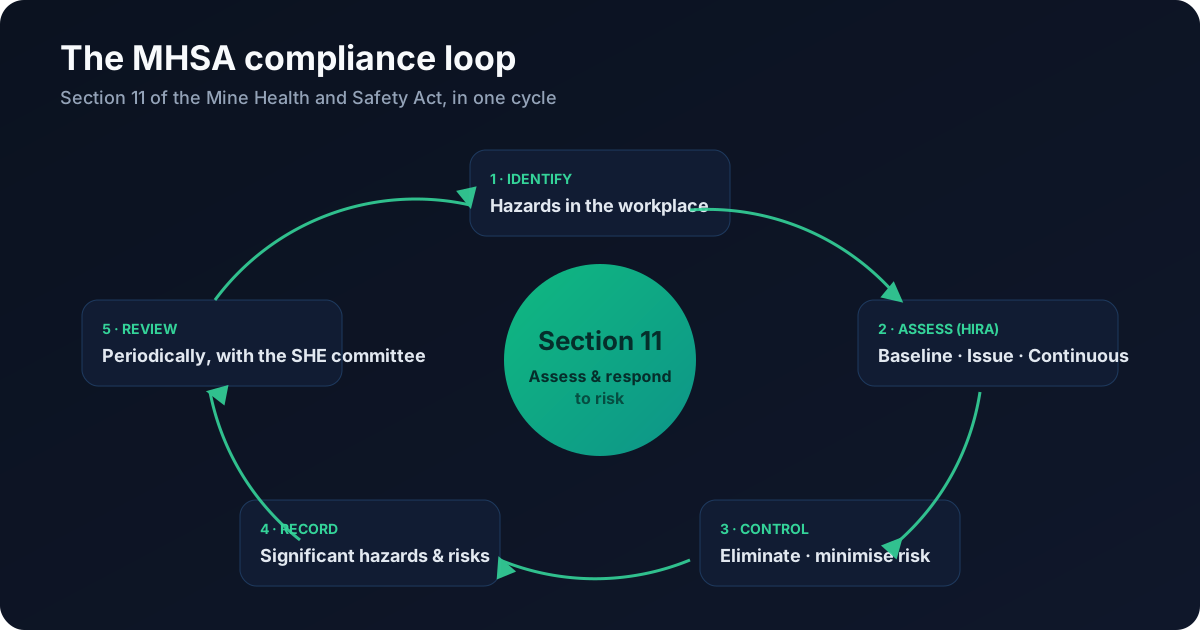
Table of Contents
MHSA compliance means running a documented, repeatable safety-management loop at your mine: identify hazards, assess the risks (HIRA), put controls in place, keep records of what you found and did, and review it all regularly. The Mine Health and Safety Act 29 of 1996 (MHSA) puts the legal duty for that loop squarely on the employer, and an inspector from the mining regulator can ask to see the evidence at any time. Get the loop right and audits become routine; leave gaps and you risk a Section 54 stoppage that halts production.
This guide walks through what the MHSA actually requires, the role of Section 11 risk assessments, the three tiers of HIRA, record-keeping expectations, and the enforcement notices you want to avoid. It links out to deeper guides on each topic as you go.
What is the MHSA and who does it apply to?
The Mine Health and Safety Act 29 of 1996 is South Africa's primary law governing health and safety at mines and works. Its central purpose is to protect the health and safety of everyone at a mine. It applies to every mine — from a large deep-level gold operation to a small surface quarry — and it places the primary legal duty on the employer (the mine owner or the person appointed to manage it). Employees carry duties too: section 22 and 23 of the Mine Health and Safety Act set out what every worker must do and when they may leave a dangerous working place.
The Act is enforced by inspectors from the mining regulator (the Mine Health and Safety Inspectorate, which sits in the Department of Mineral and Petroleum Resources, the DMPR). You can read the consolidated Act on SAFLII and the full Act with regulations on the Mine Health and Safety Council (MHSC) website.
The MHSA is built on a simple idea: the people who create the risk are the people responsible for managing it. That is why almost every obligation traces back to the employer's duty to assess and respond to risk.
What does Section 11 of the MHSA require?
Section 11 is the heart of MHSA compliance. It obliges every employer to identify hazards, assess the health and safety risks employees may be exposed to, record the significant hazards and assessed risks, and then act to eliminate, control and minimise those risks. This is the legal basis for hazard identification and risk assessment (HIRA) at every South African mine.
In practice, Section 11 requires you to:
- Identify the hazards workers may be exposed to at the mine.
- Assess the risk attached to each hazard.
- Record the significant hazards identified and the risks assessed.
- Determine and implement control measures — after consulting the health and safety committee — to eliminate, control and minimise the risk, as far as reasonably practicable.
- Engage qualified people (for example occupational hygiene techniques) to measure exposures where necessary.
- Review the hazards and risks periodically, including the results of occupational-hygiene measurement and medical surveillance.
The legal standard is "reasonably practicable" — you weigh the severity and scope of the risk against the knowledge available and the means of removing or mitigating it. We break the whole obligation down in Section 11 of the MHSA explained.
What is HIRA, and what are the three types?
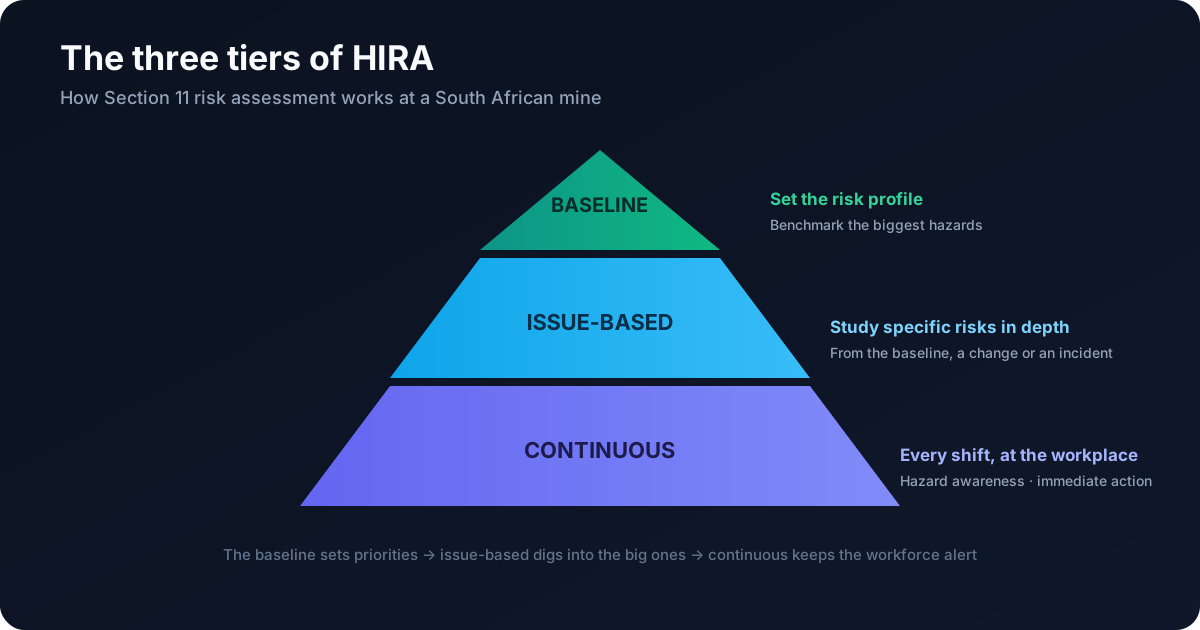
HIRA — hazard identification and risk assessment — is how you satisfy Section 11 in the field. The MHSA framework recognises three complementary tiers of risk assessment, and a compliant mine runs all three:
| Type | Purpose | When |
|---|---|---|
| Baseline HIRA | Establish the mine's overall risk profile and benchmark the biggest hazards | Once, then reviewed periodically |
| Issue-based HIRA | Study a specific process, change or high-priority risk in depth | Triggered by the baseline, a change, or an incident |
| Continuous HIRA | Day-to-day hazard awareness and immediate risk treatment at the workplace | Every shift, continuously |
The baseline sets your priorities, issue-based assessments dig into the big ones, and continuous risk assessment keeps the workforce alert shift-to-shift. We explain how they fit together in Baseline vs issue-based vs continuous HIRA.
Reality: most audit findings do not come from missing a baseline HIRA — they come from continuous risk assessments that were done on paper and never captured, or issue-based recommendations that were never closed out.
What are the MHSA record-keeping requirements?
If it is not recorded, it did not happen — at least as far as an inspector is concerned. Section 11 explicitly requires you to record the significant hazards identified and the risks assessed, and other parts of the Act and regulations require records of inspections, appointments, training, medical surveillance and incidents.
When an inspector arrives, they typically want to see:
- Your baseline, issue-based and continuous risk assessments — current and dated.
- Records of the controls you put in place and evidence they are working.
- Legal appointments and competency/training records for the people doing safety-critical work.
- A clear trail from a hazard being found to it being fixed (your corrective-action or "loop closure" history).
This is where paper-based systems fall down: records are slow, get lost, and cannot be searched under audit pressure. Digitising the record — with photos, timestamps and GPS captured at the point of inspection — is the single biggest reliability upgrade most mines can make. That is exactly what Inspecable's safety & compliance platform is built for, including full offline capture underground where there is no signal.
What is a Section 54 vs a Section 55 notice?
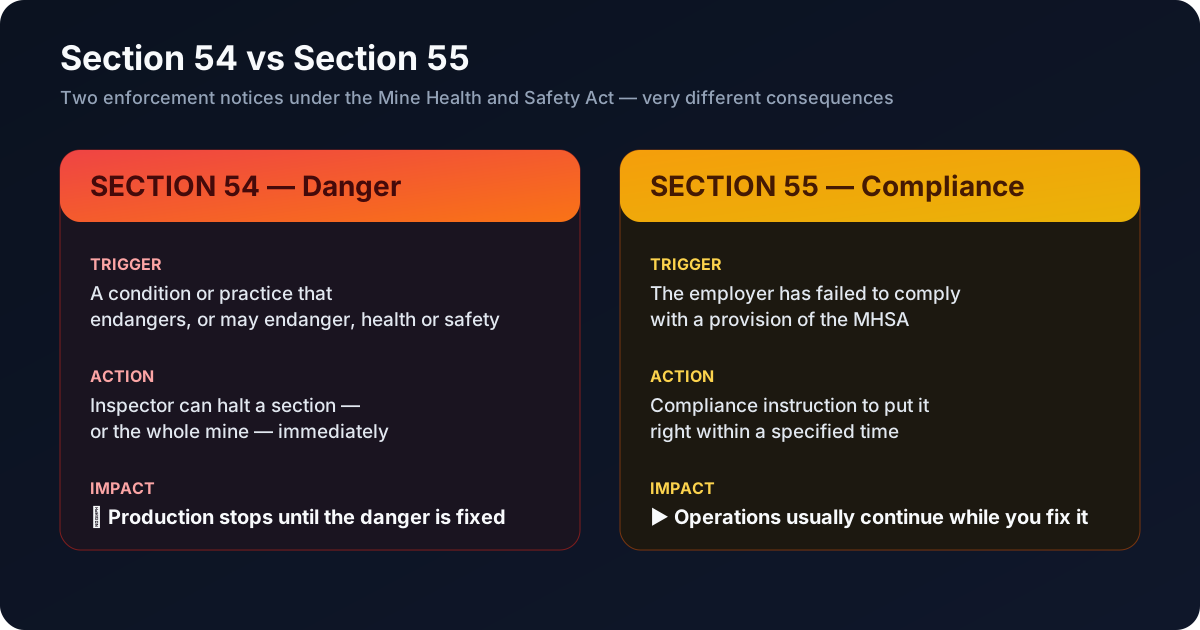
These are the two enforcement notices every mine manager needs to understand — because they behave very differently.
- Section 54 applies when an inspector believes an occurrence, practice or condition endangers or may endanger health or safety. The inspector can halt a section of the mine, or the whole mine, until the danger is dealt with. This is the notice that stops production.
- Section 55 applies when an inspector believes the employer has failed to comply with a provision of the MHSA. It is a compliance instruction to put things right within a specified time — and, unlike Section 54, it does not necessarily stop operations.
In short: Section 54 is about immediate danger and can shut you down; Section 55 is about compliance and gives you time to fix it. We cover both — and how to reduce your exposure — in Section 54 vs Section 55 notices explained.
How do you actually stay audit-ready?
Audit-readiness is not a scramble before an inspection — it is the natural by-product of running the compliance loop well every day. Four habits make the difference:
- Capture at the source. Do inspections and continuous HIRA on a mobile device in the field, with photos and timestamps, not on paper transcribed later.
- Close the loop. Every finding should become a tracked corrective action with an owner and a due date, so the same hazard does not keep reappearing.
- Keep competencies current. Expired certificates can invalidate inspections and trigger findings — track them.
- Make records searchable. When an inspector asks for "the risk assessment for that section," you should produce it in seconds.
Our step-by-step checklist for the day itself is in How to prepare for a Mine Health and Safety Inspectorate audit.
Where Inspecable fits
Inspecable is a South-African-built inspection and compliance platform designed around the MHSA loop: inspections that run offline on Android, underground included, with photo evidence and a signature on each step; every failed item becoming a tracked action with an owner and a due date; closure that needs a method, evidence and a signature; and a date-range export of completed inspections as one ZIP, with an index spreadsheet and each signed PDF. It is priced for mid-tier operations in rands — see pricing.
If you are moving off paper or replacing a system that does not understand SA mining law, book a demo and we will walk it through against your own operation.
Frequently asked questions
What is MHSA compliance?
MHSA compliance means meeting the duties in the Mine Health and Safety Act 29 of 1996 — chiefly the employer's Section 11 duty to identify hazards, assess risks, record significant hazards and risks, and implement controls to eliminate, control and minimise risk as far as reasonably practicable, then review it periodically.
Who is responsible for MHSA compliance at a mine?
The employer — the mine owner or the person appointed to manage the mine — carries the primary legal duty. Responsibilities are delegated through legal appointments, but the employer remains accountable for assessing and responding to risk.
What is the difference between a Section 54 and a Section 55 notice?
A Section 54 notice is issued when an inspector believes a condition or practice endangers health or safety, and it can stop part or all of the mine until the danger is resolved. A Section 55 notice is a compliance instruction for failing to comply with the Act, requiring the employer to remedy the issue within a set time, usually without halting operations.
How do mines prepare for an MHSA audit?
By running the compliance loop daily: capturing inspections and HIRA digitally at the source with photo and timestamp evidence, turning every finding into a tracked corrective action, keeping competency records current, and storing records so they can be produced in seconds when an inspector asks.
References
- [1]Mine Health and Safety Act 29 of 1996 (consolidated) — SAFLII: https://www.saflii.org/za/legis/consol_act/mhasa1996192/
- [2]Mine Health and Safety Act and Regulations — Mine Health and Safety Council (MHSC): https://www.mhsc.org.za/
- [3]Mine Health and Safety Inspectorate — Department of Mineral and Petroleum Resources (DMPR): https://www.dmre.gov.za/
Ready to Transform Your Mining Operations?
Run your inspections on a phone with no signal, and close every failed item with evidence and a signature.
About Inspecable Team
Mining Safety & Compliance Specialists
We help South African mines and process plants run inspections offline on Android, turn every failed item into a tracked action with an owner and a due date, and close actions only with a method, evidence and a signature.
Related Articles
Section 11 of the MHSA Explained: Your Risk-Assessment Obligations
Section 11 is the legal heart of MHSA compliance. It tells every employer to identify hazards, assess the risk, record it, control it and review it. Here is what each duty means in practice.
Baseline vs Issue-Based vs Continuous HIRA: The Three-Tier Model
A compliant mine runs three kinds of HIRA. The baseline sets the risk profile, issue-based digs into the big risks, and continuous keeps the workforce alert every shift. Here is how they fit together.
Section 54 vs Section 55 Notices Explained (and How to Avoid Them)
Section 54 responds to danger and can stop your mine. Section 55 responds to non-compliance and gives you time to fix it. Here is exactly how they differ — and how to avoid both.