Section 11 of the MHSA Explained: Your Risk-Assessment Obligations

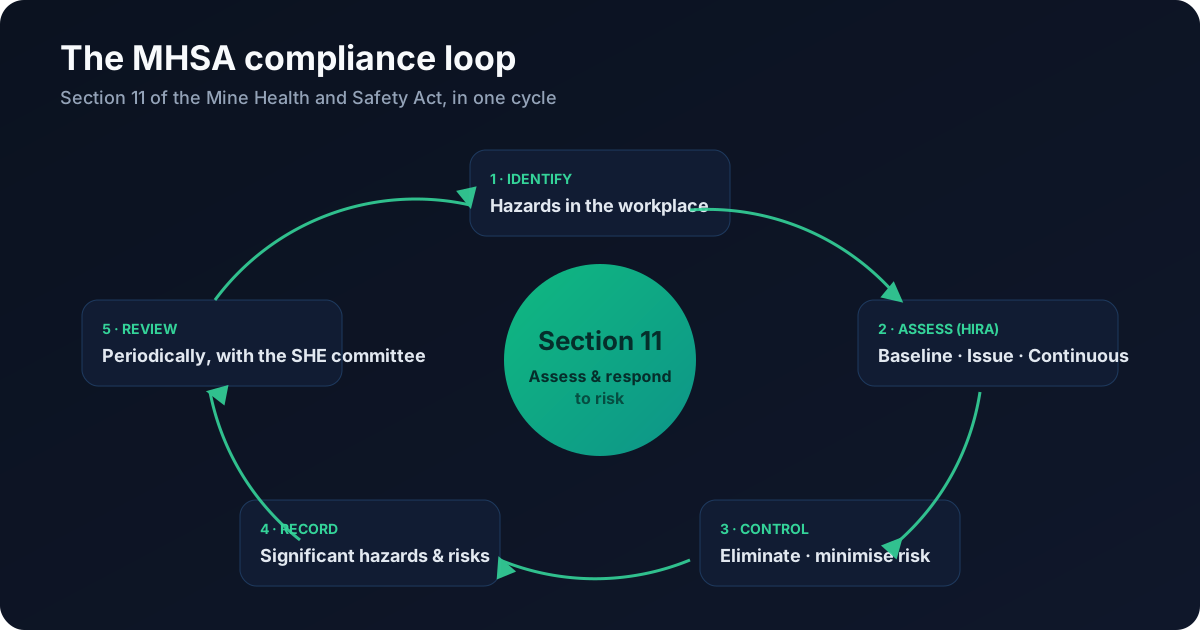
Section 11 of the Mine Health and Safety Act 29 of 1996 requires every employer to identify the hazards at the mine, assess the health and safety risks employees may be exposed to, record the significant hazards and assessed risks, and then implement measures to eliminate, control and minimise those risks — as far as reasonably practicable. It is titled "Employer to assess and respond to risk", and it is the legal basis for hazard identification and risk assessment (HIRA) at every South African mine.
If you only understand one section of the MHSA, make it this one. Almost every other duty — training, record-keeping, controls, medical surveillance — flows from the risk assessment Section 11 demands. This guide breaks the obligation into its parts.
What does Section 11 actually say?
In plain terms, Section 11 obliges the employer to:
- Identify the hazards to which employees may be exposed while at work.
- Assess the risks associated with those hazards.
- Record the significant hazards identified and the risks assessed.
- Determine and implement control measures — after consulting the health and safety committee — to eliminate, control and minimise the risk.
- Engage qualified people (for example, occupational-hygiene measurement) where necessary to quantify exposure.
- Review the hazards and risks periodically, including the results of occupational-hygiene and medical-surveillance data.
You can read the section in the consolidated MHSA on SAFLII.
What is the "hierarchy of controls" under Section 11?
Section 11 does not let you jump straight to personal protective equipment (PPE). The order matters: you must first try to eliminate the risk, then control it at source, then minimise it — and only rely on PPE where risk remains. Determining these measures must happen in consultation with the health and safety committee, which is a compliance point inspectors check. Once PPE is issued, using it and looking after it is the employee's duty under section 22 of the Mine Health and Safety Act.
What does "reasonably practicable" mean?
The standard of care in Section 11 is "reasonably practicable" — not "possible at any cost". Deciding what is reasonably practicable weighs:
- the severity and scope of the hazard or risk;
- the state of knowledge reasonably available about the hazard and the ways to remove or mitigate it; and
- the availability and suitability of means to do so.
In practice this means you must be able to show your reasoning — which is why the record-keeping duty sits right next to the assessment duty.
Reality: an inspector rarely disputes that you did a risk assessment. What triggers findings is that you cannot produce the record, or you cannot show that the controls you chose were actually implemented and reviewed.
How does Section 11 connect to HIRA?
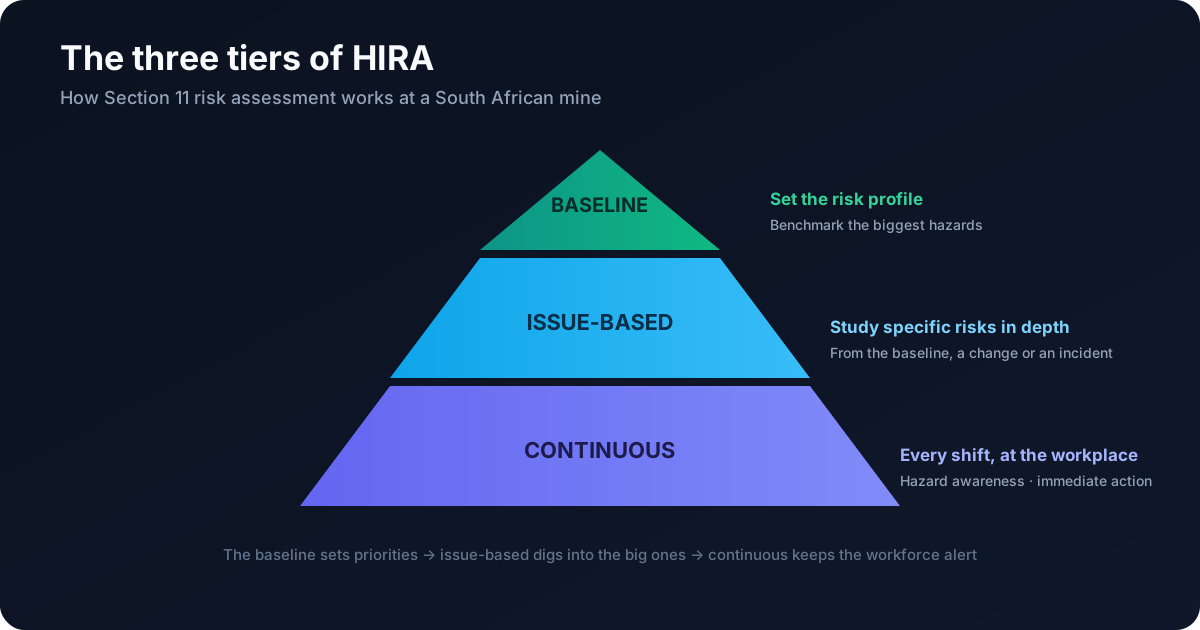
HIRA is how you satisfy Section 11 day to day, and the framework recognises three tiers — baseline, issue-based and continuous — each feeding the next. Section 11(2) is where issue-based assessments produce clear recommendations to management for further action. We explain how the three tiers work together in Baseline vs issue-based vs continuous HIRA.
How Inspecable helps with Section 11
Meeting Section 11 is really a records problem: can you identify, assess, record, control and review — and prove it? Inspecable's safety & compliance tools run inspections offline on Android, underground included, with photos and a signature captured at each step, and keep a hash-chained history of each inspection's sign-offs that you can verify with one button. Failed items become tracked actions with an owner and a due date, and an action closes only with a method, evidence and a signature, so the "review and respond" loop actually closes. For the bigger picture, start with our complete MHSA compliance guide.
Frequently asked questions
What does Section 11 of the MHSA require?
Section 11 requires every employer to identify hazards, assess the health and safety risks employees may be exposed to, record the significant hazards and assessed risks, implement controls to eliminate, control and minimise the risk after consulting the health and safety committee, and review the hazards and risks periodically.
What is the standard of "reasonably practicable" in Section 11?
It means weighing the severity and scope of the risk against the knowledge available about the hazard and the means of removing or mitigating it. It is not an absolute duty — but you must be able to show the reasoning behind the controls you chose.
Does Section 11 require records?
Yes. Section 11 explicitly requires the employer to record the significant hazards identified and the risks assessed. In practice you should also keep evidence that controls were implemented and reviewed.
References
- [1]Mine Health and Safety Act 29 of 1996, section 11 (Employer to assess and respond to risk) — SAFLII: https://www.saflii.org/za/legis/consol_act/mhasa1996192/
- [2]Mine Health and Safety Act and Regulations — Mine Health and Safety Council (MHSC): https://www.mhsc.org.za/
Ready to Transform Your Mining Operations?
Run your inspections on a phone with no signal, and close every failed item with evidence and a signature.
About Inspecable Team
Mining Safety & Compliance Specialists
We help South African mines and process plants run inspections offline on Android, turn every failed item into a tracked action with an owner and a due date, and close actions only with a method, evidence and a signature.
Related Articles
The Complete Guide to MHSA Compliance for South African Mines
MHSA compliance comes down to a repeatable loop: identify hazards, assess the risk, control it, record it, and review. Here is how each part works — and how to keep the paperwork ready for an inspector.
Baseline vs Issue-Based vs Continuous HIRA: The Three-Tier Model
A compliant mine runs three kinds of HIRA. The baseline sets the risk profile, issue-based digs into the big risks, and continuous keeps the workforce alert every shift. Here is how they fit together.
Section 54 vs Section 55 Notices Explained (and How to Avoid Them)
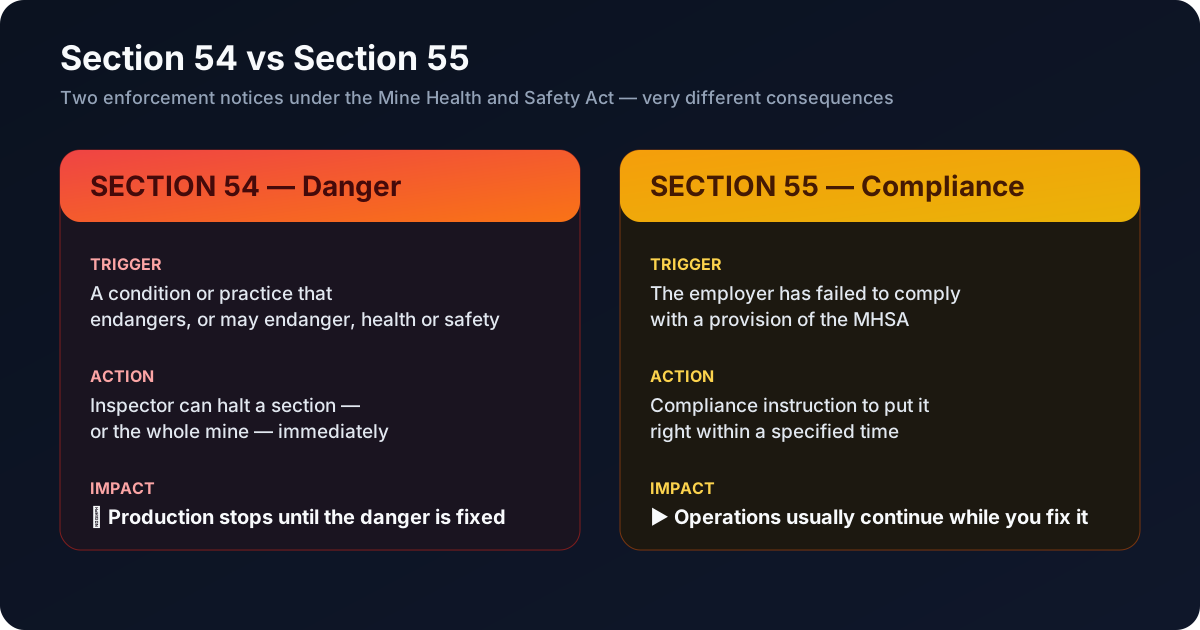
Section 54 responds to danger and can stop your mine. Section 55 responds to non-compliance and gives you time to fix it. Here is exactly how they differ — and how to avoid both.