Section 54 vs Section 55 Notices Explained (and How to Avoid Them)

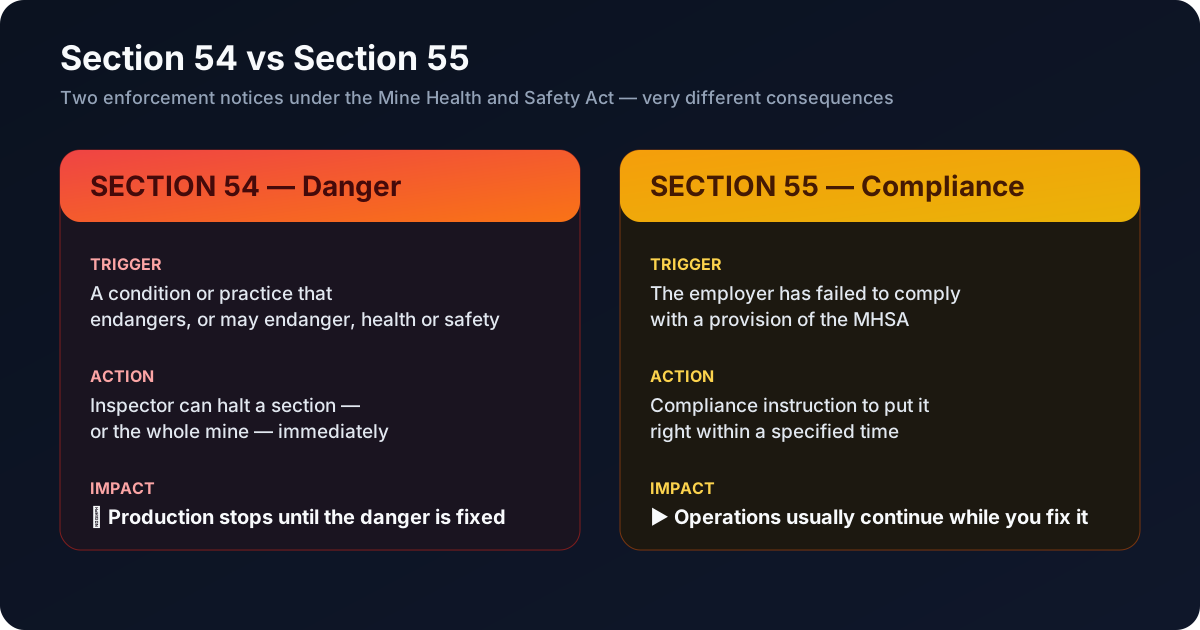
A Section 54 notice is issued when a mine inspector believes a condition or practice endangers, or may endanger, health or safety — and it can halt part or all of the mine immediately. A Section 55 notice is issued when the employer has failed to comply with a provision of the Mine Health and Safety Act, and it requires the employer to put things right within a specified time, usually without stopping operations. In short: Section 54 is about danger and can shut you down; Section 55 is about compliance and gives you time.
Both come from the enforcement powers the MHSA gives inspectors, and every mine manager should know the difference cold.
What is a Section 54 notice?
A Section 54 instruction may be issued when an inspector has reason to believe that any occurrence, practice or condition at the mine endangers or may endanger the health or safety of any person. The inspector can:
- halt a specific section, activity or piece of equipment; or
- stop the whole mine.
The instruction is meant to be limited to what is necessary to protect health and safety. It is the notice that stops production — which is why Section 54 stoppages get so much attention in the industry. Legal commentary on the scope of these powers is available from firms such as Werksmans and ENSafrica.
What is a Section 55 notice?
A Section 55 instruction may be given when an inspector has reason to believe the employer has failed to comply with a provision of the MHSA. Unlike Section 54, it is a compliance mechanism: it orders the employer to remedy the non-compliance within a specified period, and it does not necessarily stop operations.
Section 54 vs Section 55: the core difference
| Section 54 | Section 55 | |
|---|---|---|
| Trigger | A condition/practice that endangers health or safety | Failure to comply with the MHSA |
| Typical action | Stop a section or the whole mine | Fix the non-compliance within a set time |
| Stops production? | Yes, potentially immediately | Usually not |
| Nature | Immediate danger control | Compliance correction |
How do you reduce your exposure to Section 54 and 55?
You cannot eliminate an inspector's discretion, but you can remove the conditions that invite a notice:
- Find and fix dangers before the inspector does. Frequent, structured inspections and continuous risk assessment surface hazards early.
- Close the loop. Every finding should become a tracked corrective action with an owner and due date — an open, ageing finding is exactly what a Section 54 acts on.
- Keep evidence current and searchable. Being able to show risk assessments, controls and competencies on demand reduces Section 55 exposure.
- Track competencies. Expired certificates can invalidate work and become findings.
This is the daily discipline behind preparing for a mine safety audit.
Where Inspecable fits
Inspecable is built for the daily discipline above: inspections that run offline on Android so dangers are recorded where they are found, every failed item becoming a tracked action with an owner and a due date, and closure that needs a method, evidence and a signature, so a finding does not quietly age into a stoppage. See the complete MHSA compliance guide for the full picture, or book a demo.
Frequently asked questions
What is the difference between a Section 54 and a Section 55 notice?
A Section 54 notice responds to a condition or practice that endangers health or safety and can stop part or all of the mine immediately. A Section 55 notice responds to a failure to comply with the MHSA and requires the employer to fix it within a specified time, usually without stopping operations.
Does a Section 54 notice stop the whole mine?
It can. An inspector may halt a specific section, activity or piece of equipment, or the whole mine, limited to what is necessary to protect health and safety.
How can a mine reduce Section 54 stoppages?
By finding and fixing dangers before an inspection through frequent structured inspections and continuous risk assessment, closing corrective actions before they age, keeping records searchable, and tracking worker competencies.
References
- [1]Ambit of inspector powers under Section 54 of the MHSA clarified — Werksmans Attorneys: https://www.werksmans.com/legal-updates-and-opinions/ambit-of-inspector-powers-under-section-54-of-the-mine-health-and-safety-act-29-of-1996-clarified/
- [2]Managing health and safety enforcement in South African mining — ENSafrica: https://www.ensafrica.com/news/detail/11274/managing-health-and-safety-enforcement-in-sou
- [3]Mine Health and Safety Act 29 of 1996 — SAFLII: https://www.saflii.org/za/legis/consol_act/mhasa1996192/
Ready to Transform Your Mining Operations?
Run your inspections on a phone with no signal, and close every failed item with evidence and a signature.
About Inspecable Team
Mining Safety & Compliance Specialists
We help South African mines and process plants run inspections offline on Android, turn every failed item into a tracked action with an owner and a due date, and close actions only with a method, evidence and a signature.
Related Articles
The Complete Guide to MHSA Compliance for South African Mines
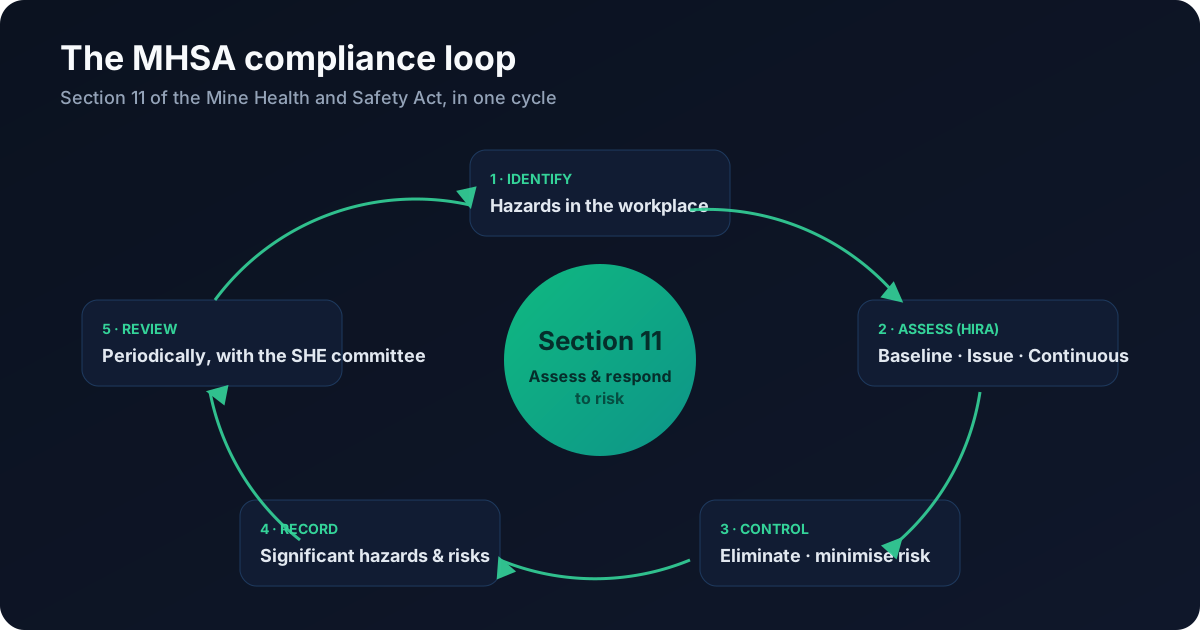
MHSA compliance comes down to a repeatable loop: identify hazards, assess the risk, control it, record it, and review. Here is how each part works — and how to keep the paperwork ready for an inspector.
How to Prepare for a Mine Health and Safety Inspectorate Audit (what most people still call a DMRE audit)
An inspector will ask for your risk assessments, records, appointments and evidence that findings were closed. Here is the checklist to have ready — and how to make audit-readiness a by-product of daily work.
Section 11 of the MHSA Explained: Your Risk-Assessment Obligations
Section 11 is the legal heart of MHSA compliance. It tells every employer to identify hazards, assess the risk, record it, control it and review it. Here is what each duty means in practice.