How a permit to work system works in practice


A permit to work (PTW) system is a controlled sequence for work that normal procedures do not make safe enough: someone asks for the work, the hazards are assessed and an isolation plan is written, the isolations are applied and then verified by a second person, the named signatories sign in order, the work runs within the permit's limits, it is handed over or suspended at shift change, and it is closed out only when the locks are off, the isolations are reinstated and the area has been checked. The form is the least important part. The sequence, and the fact that no step can be skipped, is the system.
This post walks the sequence as it runs on a site, names the three points where it usually breaks, and describes what a working system does about each.
When do you need a permit to work?
A permit is for work where the hazard cannot be removed and the control depends on people doing things in the right order. The usual cases on a South African plant or mine:
- Hot work near flammable material.
- Confined space entry, the classic permit case under regulation 5 of the OHS Act's General Safety Regulations.
- Work at height where fall protection must be rigged and checked.
- Electrical and mechanical isolation before maintenance on energised or pressurised equipment.
- Excavation near buried services.
A site that permits everything has a queue, not a safety system. Decide which tasks need a permit, write it down, and put the rest under a standard procedure and a pre-task risk assessment.
What are the steps in a permit to work?
- Request. The person who will run the work (the performing authority) describes the task, the location, the equipment and the time window.
- Risk assessment and isolation plan. The hazards are listed, controls are chosen, and every energy source to be isolated is named: which valve, which breaker, which lock.
- Isolate. Each isolation is applied and locked. The person applying it records it.
- Verify. A second person checks each isolation independently: tries the start button, checks the gauge reads zero, sees the lock. This is the step most often skipped, and the one that matters most.
- Sign. The issuing authority confirms the area is ready; the performing authority accepts the permit and its conditions; the area owner signs where the site's procedure requires it. The permit is not live until the last required signature is on it.
- Work within limits. The permit states what work, where, by whom and until when. Work outside that is a new permit.
- Suspend or hand over. At shift change the permit is either suspended (work stops, isolations stay) or handed over to a named person who signs for it.
- Close out. Tools and people are out, isolations are reinstated in order, locks are removed, the area is inspected, and the permit is closed and kept.
Where do permit systems fail?
Three places, in nearly every investigation.
Isolations assumed, not verified. The plan said "isolate breaker 4" and someone ticked it, and nobody tried the start button. Verification by a second person is the control; a tick in the same handwriting is not.
Permits signed away from the job. A permit issued from an office, on a description, is a promise about an area nobody has looked at. The issuing authority should sign at the location, after the isolations are verified.
Close-out that never happens. The work finishes, the crew leaves, the permit stays open, and the next shift finds a lock on a valve nobody can account for. An open permit with a lock still on is a live hazard and a finding.
Paper permits add a fourth: the record goes missing. When an inspector asks for last month's hot-work permits, the answer should not depend on a box.
What does a working permit to work system look like?
- The permit types and the tasks they cover are written down and short.
- The isolation plan names each point, and each point has an apply record and a separate verify record.
- The permit cannot go live until every named signatory has signed, and signatures are made at the location.
- Handover is explicit: a named person accepts the permit, or it is suspended.
- Close-out requires the locks to be removed and the isolations reinstated before the permit can be closed.
- Every permit, live or closed, can be produced with its history.
The permit to work template lays out these steps on paper for a site that is starting from nothing.
Where Inspecable fits
In Inspecable a permit cannot go active until every signatory has signed and every isolation has been verified by a second person, and it cannot be closed while a lock is still recorded against it. Permits and lockout run on the web dashboard; the related inspections, toolbox talks and corrective actions run on the Android app, offline. Each permit keeps a history you can verify. For the records the rest of the plant needs to hold, see what the Pressure Equipment Regulations require you to record, and for the wider move off paper, digitising mine safety: from paper to records you can produce.
Frequently asked questions
What is a permit to work?
A permit to work is a documented, signed authorisation for work that normal procedures do not make safe enough, such as hot work, confined space entry or work on isolated equipment. It records the hazards, the isolations applied and verified, the named signatories, the limits of the work, and the close-out.
Who signs a permit to work?
At minimum the issuing authority, who confirms the area and isolations are ready, and the performing authority, who accepts the permit and its conditions. Many sites add the area owner. The person who verifies each isolation signs separately from the person who applied it.
What happens to a permit at shift change?
It is either suspended, meaning the work stops while the isolations stay in place, or handed over to a named person on the next shift who signs to accept it. A permit should never carry on with nobody responsible for it.
References
- [1]General Safety Regulations, regulation 5 (work in confined spaces), made under the Occupational Health and Safety Act 85 of 1993 — Department of Employment and Labour: https://www.labour.gov.za/
- [2]ISO 45001:2018, clause 8.1 (operational planning and control) — International Organization for Standardization: https://www.iso.org/standard/63787.html
Ready to Transform Your Mining Operations?
Run your inspections on a phone with no signal, and close every failed item with evidence and a signature.
About Inspecable Team
Safety, Inspection and Field Operations
We build safety, inspection and asset management software for South African mines, process plants, manufacturing sites, utilities and heavy-equipment fleets.
Related Articles
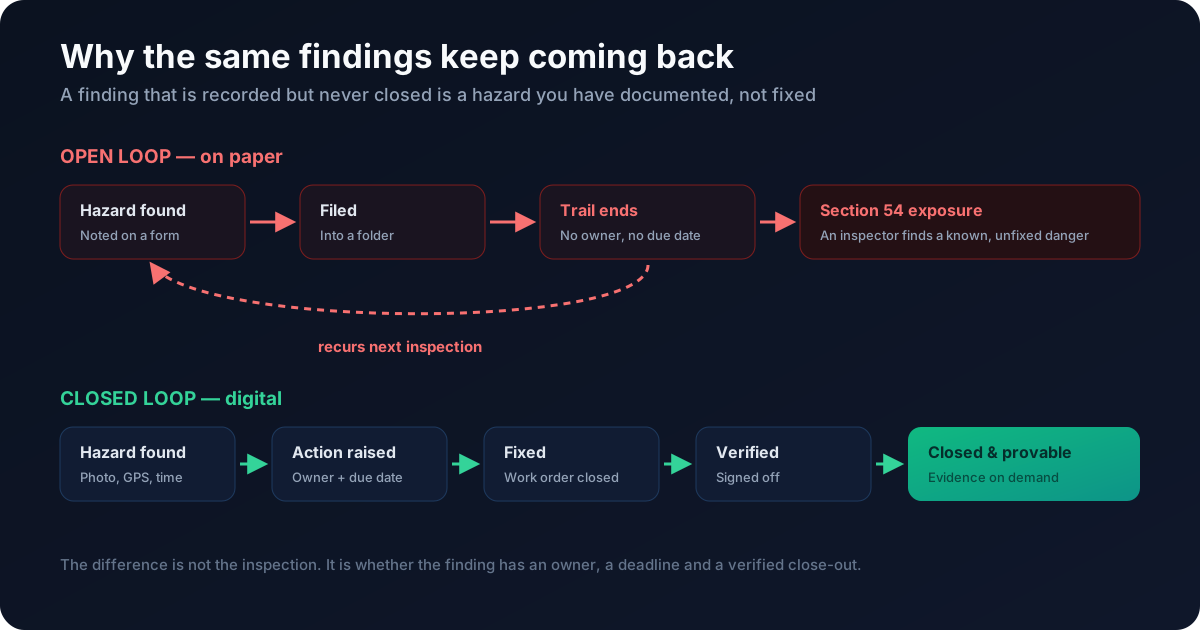
Digitising Mine Safety: From Paper to Records You Can Produce
Paper does not fail because it is old-fashioned. It fails because a finding written on a form has no owner, no deadline and no proof it was fixed. Here is what changes when the record becomes data.

What the Pressure Equipment Regulations require you to record
A pressure vessel without its records is, to an inspector, a pressure vessel without a history. Here are the records the Pressure Equipment Regulations expect a user to hold, and how to keep them current without a filing cabinet.
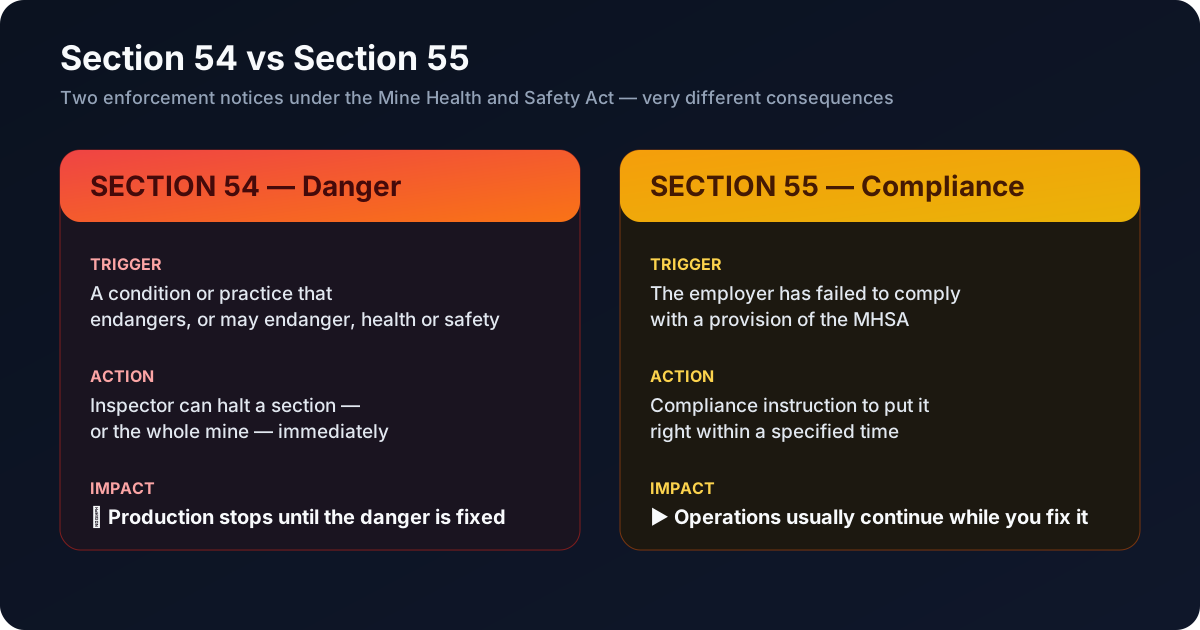
Section 54 vs Section 55 Notices Explained (and How to Avoid Them)
Section 54 responds to danger and can stop your mine. Section 55 responds to non-compliance and gives you time to fix it. Here is exactly how they differ — and how to avoid both.