What the Pressure Equipment Regulations require you to record


The Pressure Equipment Regulations (PER), made under the Occupational Health and Safety Act in 2009, put the duty to keep records on the user of the equipment. For every item of pressure equipment in scope a plant should be able to show what it is and what category it falls in, the manufacturer's certificate and design records, its registration where the regulations require one, every inspection and test by an approved inspection authority with the date of the next one, and every repair or modification with the inspection authority's involvement. The regulations require that record to be kept and open to an inspector; keeping it for the life of the equipment is the sensible practice. The regulations say little about the format. They say a great deal about what must exist.
This post lists the records, explains where each one comes from, and shows how a plant integrity manager keeps them current without a filing cabinet.
Which equipment do the Pressure Equipment Regulations cover?
The PER apply to pressure equipment with a design pressure of 50 kPa or more: steam generators, pressure vessels, piping, pressure accessories, safety accessories, transportable gas containers and the systems they form part of. SANS 347 is the standard the regulations use to sort equipment into hazard categories according to fluid, pressure and volume, and the category decides how much involvement the approved inspection authority (AIA) has in design, manufacture and inspection.
At a mine the Mine Health and Safety Act and its regulations govern the same equipment. This post covers plants, works and factories under the OHS Act, where the Department of Employment and Labour is the regulator.
What records does a user have to keep?
Working through the regulations, the records fall into five groups.
1. The equipment itself
For every item in scope: a unique identifier, what it is, its SANS 347 category, design pressure and temperature, the fluid, where it is installed, and who the AIA is. In practice this is an equipment register with one row per vessel, steam generator or piping system.
2. Design and manufacture
The manufacturer's certificate of conformity or manufacture, the design code, the data book or drawings, and the AIA's certificate from manufacture or import where the category requires one. The regulations place duties on manufacturers, importers and suppliers to provide these; the user’s duty is to keep them in the equipment record, open to an inspector.
3. Registration
A steam generator must be registered with the Department of Employment and Labour before it is used, and the registration number travels with the equipment. The registration certificate and the correspondence that produced it belong with the equipment record.
4. Inspection and test
The regulations require the user to have pressure equipment inspected and tested by an AIA at set intervals. For steam generators the regulations fix a maximum interval between inspections; for other equipment the interval follows the health and safety standards the regulations incorporate and the equipment's category. Each inspection produces an AIA certificate or report, and the record should carry the date, what was done, the result, any conditions attached, and the date the next inspection falls due.
5. Repairs and modifications
A repair or modification to pressure equipment must be carried out to the applicable code, with the AIA involved as the regulations require, and the record of it kept with the equipment. A vessel that was welded in the yard in 2019 with no record of who inspected the weld is a finding waiting to happen.
What records are not required but are worth keeping anyway?
Two kinds of record are not written into the regulations but are what an inspector, an insurer and your own engineers will ask for next:
- Operator checks. Pre-start and daily checks on a steam generator (water level, safety valve, gauges) are the record that the equipment was being run as intended between statutory inspections.
- Thickness readings. Where corrosion or erosion is a known mechanism, wall-thickness readings at fixed condition monitoring locations (CMLs) against the minimum allowable thickness are what turns a 36-month inspection interval into a defensible one.
The asset register template gives the one-row-per-item layout; the monthly safety report is where overdue statutory inspections should appear.
Where Inspecable fits
In Inspecable each vessel or steam generator is an asset in the asset register with custom fields for category, design pressure, AIA and registration number. The data book, AIA certificates and registration sit on the asset as documents with versions and expiry badges, so the next inspection date is visible without opening a file. Operator checks are run on the Android app, offline, with a failed item raising a tracked issue with a due date on the spot. CML wall-thickness readings are recorded against the minimum you set and raise a corrective action when they fall below it, and isometric drawings carry revision control. For the longer story of moving a plant's records off paper, see digitising mine safety: from paper to records you can produce.
Frequently asked questions
What records do the Pressure Equipment Regulations require a user to keep?
For each item of pressure equipment: an identification and category record, the manufacturer's certificate and design records, the registration where the regulations require one (steam generators), every inspection and test by an approved inspection authority with the next due date, and every repair or modification. The regulations require the record to be kept and open to an inspector; keeping it for the life of the equipment is the sensible practice.
Does a steam generator have to be registered in South Africa?
Yes. Under the Pressure Equipment Regulations a steam generator must be registered with the Department of Employment and Labour before it is used, and the registration record stays with the equipment.
Who may inspect pressure equipment in South Africa?
An approved inspection authority (AIA): a body approved by the Department of Employment and Labour to inspect and test pressure equipment under the Pressure Equipment Regulations. The AIA issues the certificate or report that forms the inspection record.
References
- [1]Pressure Equipment Regulations, 2009 (Government Notice R. 734 of 15 July 2009), made under the Occupational Health and Safety Act 85 of 1993 — Department of Employment and Labour: https://www.labour.gov.za/
- [2]Occupational Health and Safety Act 85 of 1993 — SAFLII: https://www.saflii.org/za/legis/consol_act/ohasa1993273/
- [3]SANS 347: Categorisation and conformity assessment criteria for all pressure equipment — South African Bureau of Standards: https://www.sabs.co.za/
Ready to Transform Your Mining Operations?
Run your inspections on a phone with no signal, and close every failed item with evidence and a signature.
About Inspecable Team
Safety, Inspection and Field Operations
We build safety, inspection and asset management software for South African mines, process plants, manufacturing sites, utilities and heavy-equipment fleets.
Related Articles
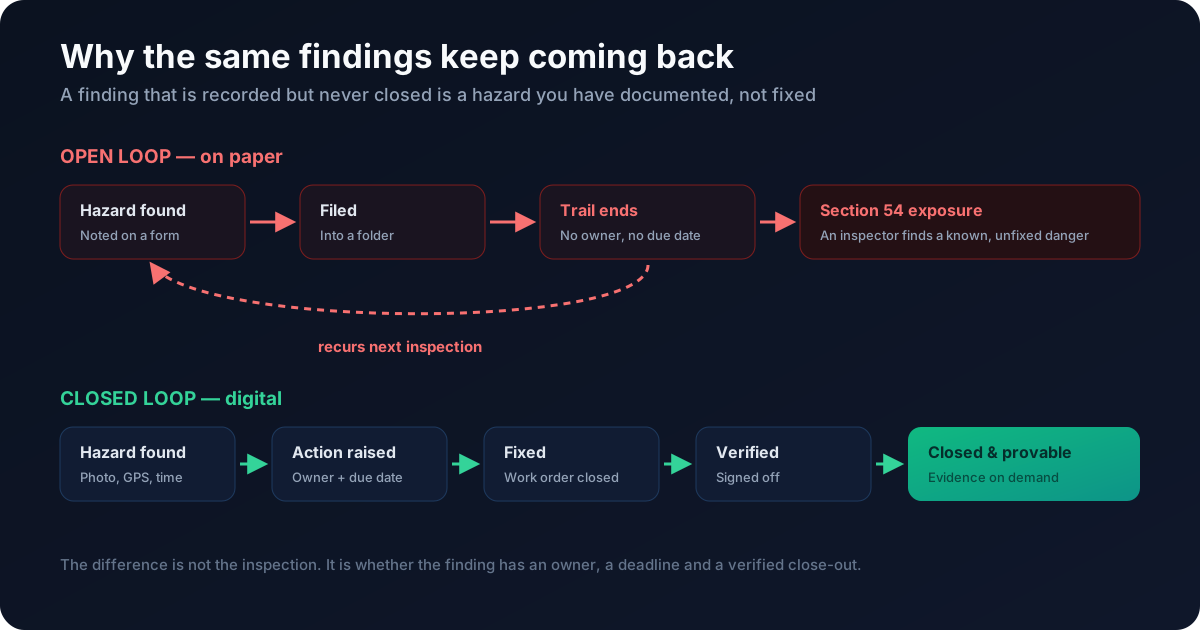
Digitising Mine Safety: From Paper to Records You Can Produce
Paper does not fail because it is old-fashioned. It fails because a finding written on a form has no owner, no deadline and no proof it was fixed. Here is what changes when the record becomes data.
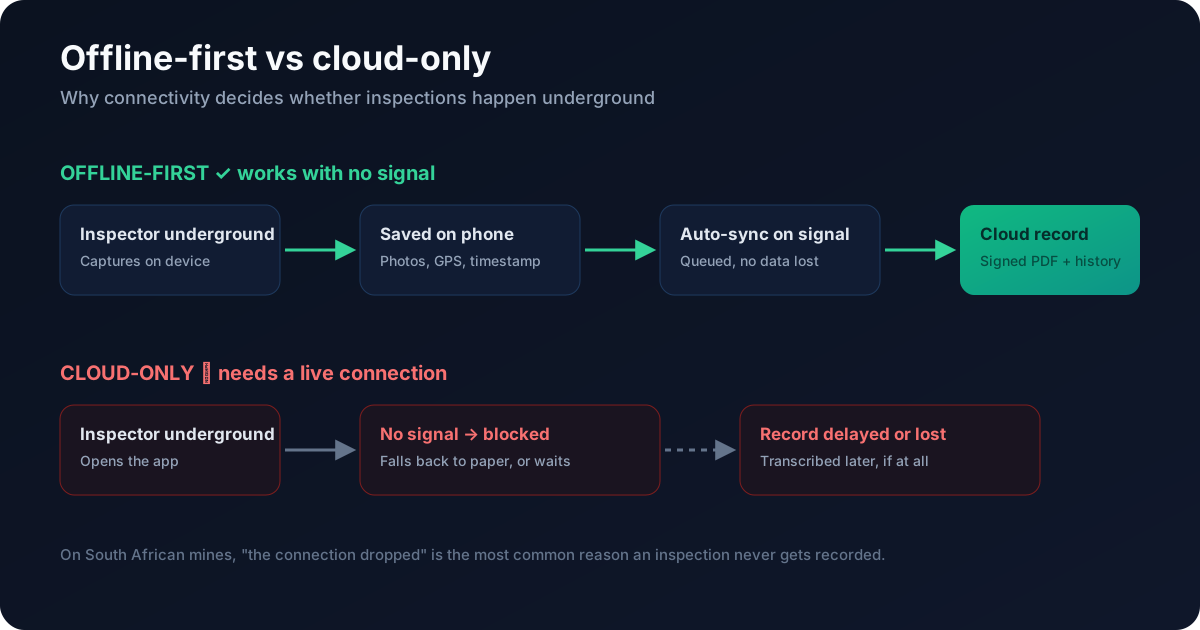
Offline-First vs Cloud Inspection Software for Mining
Cloud-only apps need a live connection — the first thing to fail underground. Offline-first apps capture on-device and sync later. Here is why that difference decides whether inspections happen at all.

How a permit to work system works in practice
Most permit systems fail at the same three points: isolations assumed rather than verified, permits signed in an office, and close-out that never happens. Here is the sequence a working permit to work system follows, step by step.