Digitising Mine Safety: From Paper to Records You Can Produce

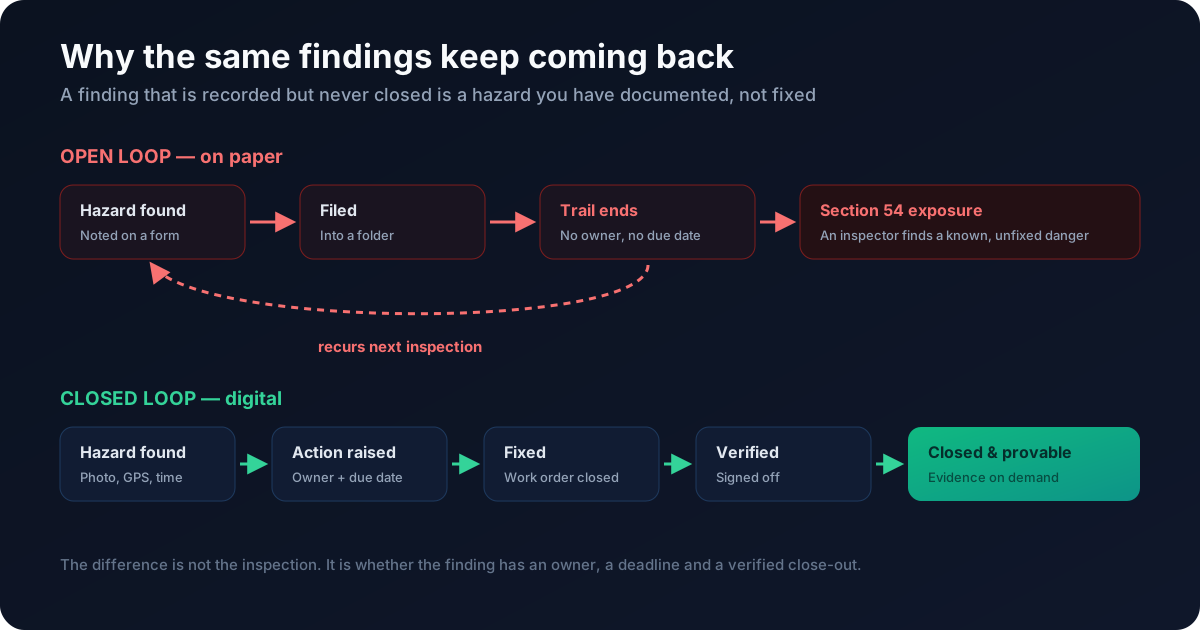
Table of Contents
Digitising mine safety means moving three things off paper: the inspection itself (captured on a device, offline, with photo and GPS evidence), the corrective action (an owned, dated task rather than a note), and the proof (a searchable record you can produce the moment an inspector asks). Mines that do only the first get faster paperwork. Mines that do all three stop the same findings recurring. That last part is what turns a safety system from a filing exercise into risk control.
This guide covers why paper-based systems fail under audit, the connectivity problem underground, and the recurrence loop that keeps hazards coming back — with links to deeper guides on each.
Why do paper-based safety systems fail an audit?
Not because the inspections were not done. They fail on three predictable points:
- Production. Section 11 of the MHSA requires you to record significant hazards and assessed risks. A record you cannot find inside an audit is functionally a record you do not have.
- Latency. A form travels from the workplace to a tray to a spreadsheet. Every hop adds days, and a defect known but not yet actioned is the worst position to be in.
- Traceability. Paper rarely shows the chain from finding to fix to verification, which is precisely what an inspector probes.
Reality: the most common audit finding is not a missing risk assessment — it is one that exists but cannot be produced, or a corrective action raised months ago that nobody closed.
We cover what the regulator actually asks for in how to prepare for a Mine Health and Safety Inspectorate audit, and the legal duty behind it in Section 11 of the MHSA explained.
How do you capture inspections underground with no signal?
You capture on the device, not in the cloud. Underground workings have no cellular coverage, so any tool that needs a live connection to load a checklist or save a record simply does not work where the risk is. Offline-first software stores the template locally, records the inspection with photo, GPS and timestamp on the phone, queues it, and syncs when the crew returns to coverage — with nothing lost in between.
The practical test is one you can run in a demo: put the device in aeroplane mode, complete a full inspection with several photos, then reconnect and confirm everything arrives intact. We compare the architectures in offline-first vs cloud inspection software.
Why do the same safety findings keep coming back?
Because the loop never closed. A finding becomes a fix only when four things exist:
- An owner — a named person, not a department.
- A due date — so the item can be overdue, and seen to be overdue.
- A completion — the actual repair or control, recorded against the finding.
- A verification — someone confirms it worked, and signs it off.
Paper systems routinely deliver the first step and none of the rest. That is why an operation can hold a thick file of inspections and still see the same guard missing, the same brake defect, the same blocked walkway quarter after quarter. Recurring findings are also what makes a Section 54 stoppage more likely: an inspector who finds a known, documented, unfixed danger is looking at a system that saw the risk and did not act.
| Paper | Closed-loop digital | |
|---|---|---|
| Finding recorded | Yes | Yes, with photo/GPS/time |
| Owner and deadline | Rarely | Always |
| Overdue visibility | None | Dashboard and alerts |
| Verified close-out | Ad hoc | Required to close |
| Provable at audit | Slow, if at all | Seconds |
What should you digitise first?
Sequence matters more than scope. In order:
- Continuous risk assessment and pre-use checks — the highest-volume, most-often-lost records. See the three tiers of HIRA.
- Corrective actions — close the loop before adding more inputs, or you just generate findings faster.
- Competencies and certificates — expired tickets quietly invalidate work.
- Baseline and issue-based assessments — the structured documents, once the daily flow is reliable.
Digitising step 4 before steps 1 and 2 is the common mistake: it produces impressive documents on top of a workplace record that is still on paper.
Where Inspecable fits
Inspecable was built for this sequence in South African mining: inspections that run offline on Android, underground included; every failed item becoming a tracked action with an owner and a due date; closure that needs a method, evidence and a signature; and a date-range ZIP export, an index spreadsheet plus each signed PDF, whenever a regulator asks. Pricing is per user and per asset in rands — see pricing — or book a demo and we will walk it through against your own operation. For the full compliance picture, start with our complete guide to MHSA compliance.
Frequently asked questions
Why do paper-based safety systems fail audits?
Usually not because inspections were skipped, but because the record cannot be produced quickly, takes days to travel from the workplace to a register, and does not show the chain from finding to fix to verification. Section 11 of the MHSA requires significant hazards and assessed risks to be recorded, and a record that cannot be found under audit is functionally missing.
How do you do safety inspections underground with no signal?
Use offline-first software that stores templates on the device, captures the inspection with photo, GPS and timestamp locally, then syncs automatically when the crew returns to coverage. Tools that need a live connection to load or save cannot record where there is no cellular coverage.
Why do the same safety findings keep recurring?
Because the corrective-action loop never closes. A finding only becomes a fix when it has a named owner, a due date, a recorded completion and a verification sign-off. Paper systems typically capture the finding and none of the other three, so the same hazards reappear at the next inspection.
What should a mine digitise first?
Continuous risk assessments and pre-use checks first, because they are the highest-volume and most frequently lost records. Then corrective actions, so findings actually close. Then competencies and certificates. Structured baseline and issue-based assessments last — digitising those first produces polished documents on top of a workplace record that is still on paper.
References
- [1]Mine Health and Safety Act 29 of 1996, section 11 (Employer to assess and respond to risk) — SAFLII: https://www.saflii.org/za/legis/consol_act/mhasa1996192/
- [2]Mine Health and Safety Act and Regulations — Mine Health and Safety Council (MHSC): https://www.mhsc.org.za/
Ready to Transform Your Mining Operations?
Run your inspections on a phone with no signal, and close every failed item with evidence and a signature.
About Inspecable Team
Mining Safety & Compliance Specialists
We help South African mines and process plants run inspections offline on Android, turn every failed item into a tracked action with an owner and a due date, and close actions only with a method, evidence and a signature.
Related Articles
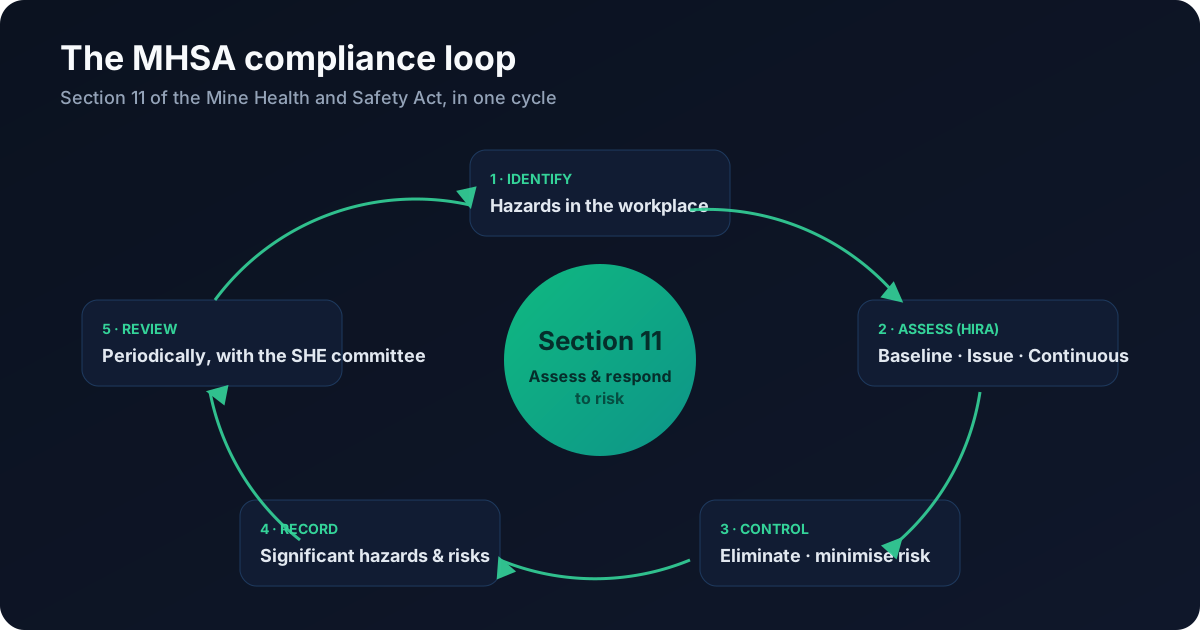
The Complete Guide to MHSA Compliance for South African Mines
MHSA compliance comes down to a repeatable loop: identify hazards, assess the risk, control it, record it, and review. Here is how each part works — and how to keep the paperwork ready for an inspector.
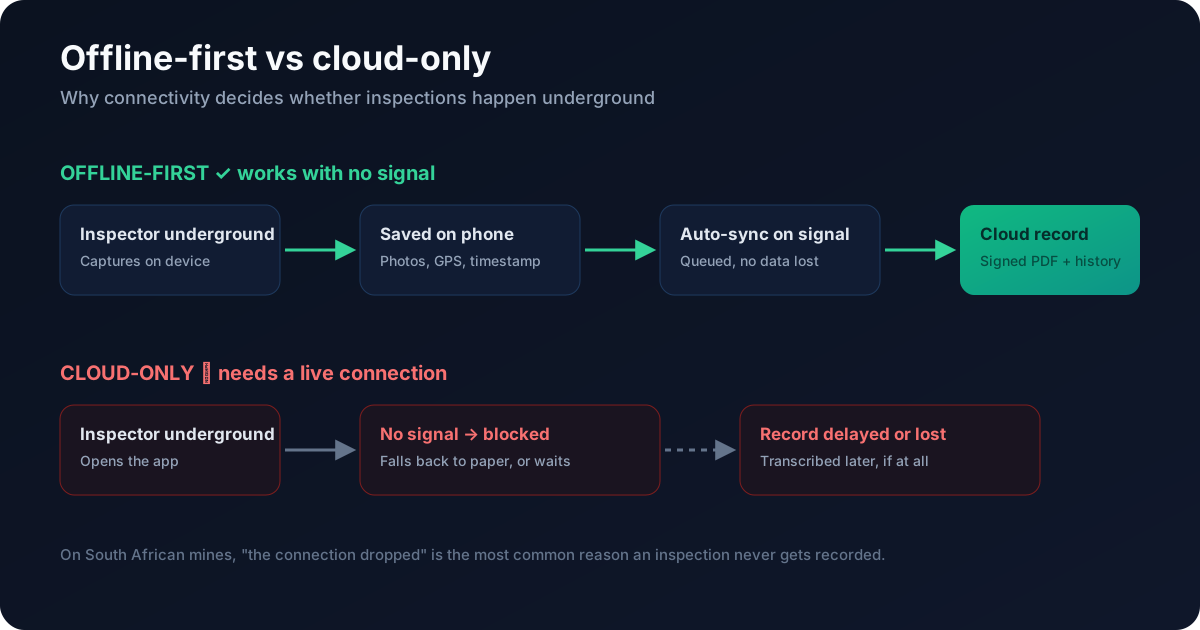
Offline-First vs Cloud Inspection Software for Mining
Cloud-only apps need a live connection — the first thing to fail underground. Offline-first apps capture on-device and sync later. Here is why that difference decides whether inspections happen at all.
How to Prepare for a Mine Health and Safety Inspectorate Audit (what most people still call a DMRE audit)
An inspector will ask for your risk assessments, records, appointments and evidence that findings were closed. Here is the checklist to have ready — and how to make audit-readiness a by-product of daily work.