How to improve near-miss reporting on a mine or plant


Near-miss reporting improves when four things are true: reporting takes a minute on the device the worker already carries, including underground with no signal; nobody is blamed for reporting; every report visibly gets an owner, a due date and an answer; and the crew hears what was done about last week's reports at this week's toolbox talk. Rates fall when any of those is missing, and no poster or incentive scheme replaces them. On a South African mine the duty to report is already in the law: section 22 of the Mine Health and Safety Act requires an employee to report promptly any risk they cannot deal with themselves. The question is not whether workers should report. It is whether the site makes that possible.
This post covers why reporting stops, six practical changes that restart it, and what to do with the reports once they arrive.
Why do crews stop reporting near misses?
Ask a crew directly and the answers are consistent:
- It takes too long. A paper form at the waiting place, filled in after a ten-hour shift, with carbon copies.
- Nothing happens. The form goes into a file. The hazard is still there next week.
- Someone gets blamed. The report names a person, or reads as if it does, and the person who reported it is the one who gets the questions.
- There is no signal. The site rolled out an app that needs a connection, and the working place is 800 metres underground.
- The numbers are a target. A site that celebrates zero near misses has told its crews what it wants to hear.
Every one of these is a system problem, not a worker problem.
What are the six changes that improve near-miss reporting?
1. Make it a minute on a phone, offline
Three taps, a photo, a sentence, done. The app must work with no signal and sync when the worker is back in range. If reporting needs a desk, it will wait for the desk, and then it will wait forever.
2. Put the no-blame rule in writing, and act on it
A one-line policy, signed by the mine manager or plant manager: a near-miss report is never used in a disciplinary process against the person who reported it. Then keep to it, visibly, the first time it is tested.
3. Give every report an owner and a due date
A report that nobody owns is a complaint. A report with a named owner and a due date is a corrective action. The supervisor assigns it on the spot; the owner closes it with what was done and a photo.
4. Close the loop back to the reporter
The person who reported it should hear what happened. A note on the record, a word at the start of shift. This is the single most effective change on most sites, and it costs nothing.
5. Talk about last week's reports at the toolbox talk
Three reports, what was done, what is still open. Crews report what they see being acted on.
6. Measure the ratio, not the count
Track near-miss reports against recorded incidents. A rising ratio means the site is hearing about more of what happens before it hurts someone. A site with many incidents and no near misses is not safe; it is quiet.
What do you do with the reports?
Most near misses need a simple fix, recorded and closed. The ones that could have been serious need a root cause: a 5-Whys or a fishbone with the crew who were there, and a corrective action that changes the condition, not just the instruction. Section 11 of the MHSA requires significant hazards and the risks assessed to be recorded, and a pattern of near misses at the same place is exactly that record.
Watch for recurrence. The same near miss reported three times is a control that has failed three times, and closing each one separately is how a site stays busy and stays at risk.
The incident investigation report template covers the serious ones; the corrective action register is where every near miss should end up with an owner and a date.
Where Inspecable fits
In Inspecable a worker records a near miss, an observation or an incident on the Android app with photo and video, offline, and it syncs when the app is opened back in range. The supervisor raises a corrective action with an owner and a due date; it cannot be closed without a method, evidence and a signature, and the site sets its own escalation rules so overdue items move up the chain. 5-Whys and fishbone root cause are built in for the serious ones, and toolbox talks are recorded with a roster and photos. For the duty behind all of this, read sections 22 and 23 of the MHSA explained, and for the full framework the complete guide to MHSA compliance.
Frequently asked questions
Why do workers not report near misses?
Because reporting takes too long, nothing visible happens afterwards, the report leads to blame, the tool needs a signal the working place does not have, or the site treats a low count as a success. Each of these is a system problem the site can fix.
Is a worker legally required to report a near miss in South Africa?
On a mine, section 22 of the Mine Health and Safety Act requires every employee to report promptly to their immediate supervisor any situation they believe presents a risk to health or safety and which they cannot properly deal with themselves. A near miss that reveals such a risk falls under that duty.
How should near-miss reporting be measured?
As a ratio of near-miss reports to recorded incidents, tracked over time, rather than as a count with a target. A rising ratio means the site is hearing about more of what happens before someone is hurt.
References
- [1]Mine Health and Safety Act 29 of 1996, sections 11 and 22 — SAFLII: https://www.saflii.org/za/legis/consol_act/mhasa1996192/
- [2]Mine Health and Safety Act and Regulations — Mine Health and Safety Council (MHSC): https://www.mhsc.org.za/
Ready to Transform Your Mining Operations?
Run your inspections on a phone with no signal, and close every failed item with evidence and a signature.
About Vela Sabelo
Founder, Inspecable
Vela Sabelo founded Inspecable in Johannesburg in 2025 to make the closed-out action the outcome of an inspection: a failed item becomes a tracked action with an owner and a due date, and it cannot close without evidence and a signature. Vela writes about inspections, corrective actions and MHSA and OHS Act compliance for South African mines and plants.
Related Articles
The Complete Guide to MHSA Compliance for South African Mines
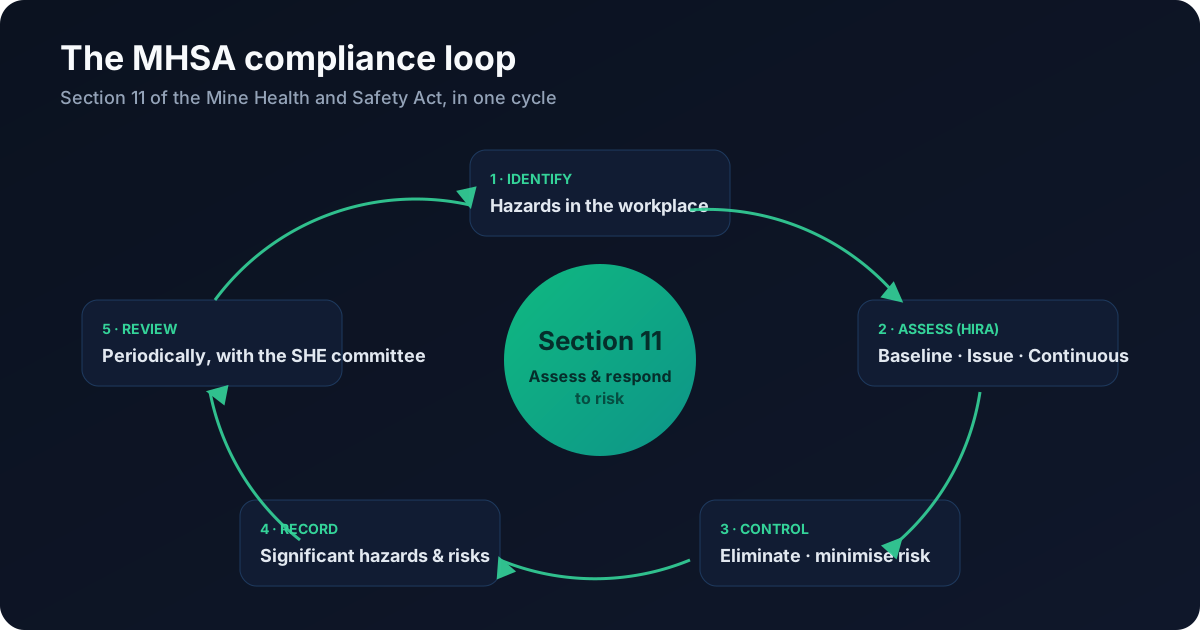
MHSA compliance comes down to a repeatable loop: identify hazards, assess the risk, control it, record it, and review. Here is how each part works — and how to keep the paperwork ready for an inspector.

Section 22 and 23 of the Mine Health and Safety Act: employee duties and the right to leave
Section 22 puts six duties on every employee at a mine. Section 23 gives them the right to leave a working place they reasonably believe is seriously dangerous. Here is what each section says, and the records a mine should be able to show for both.
Digitising Mine Safety: From Paper to Records You Can Produce
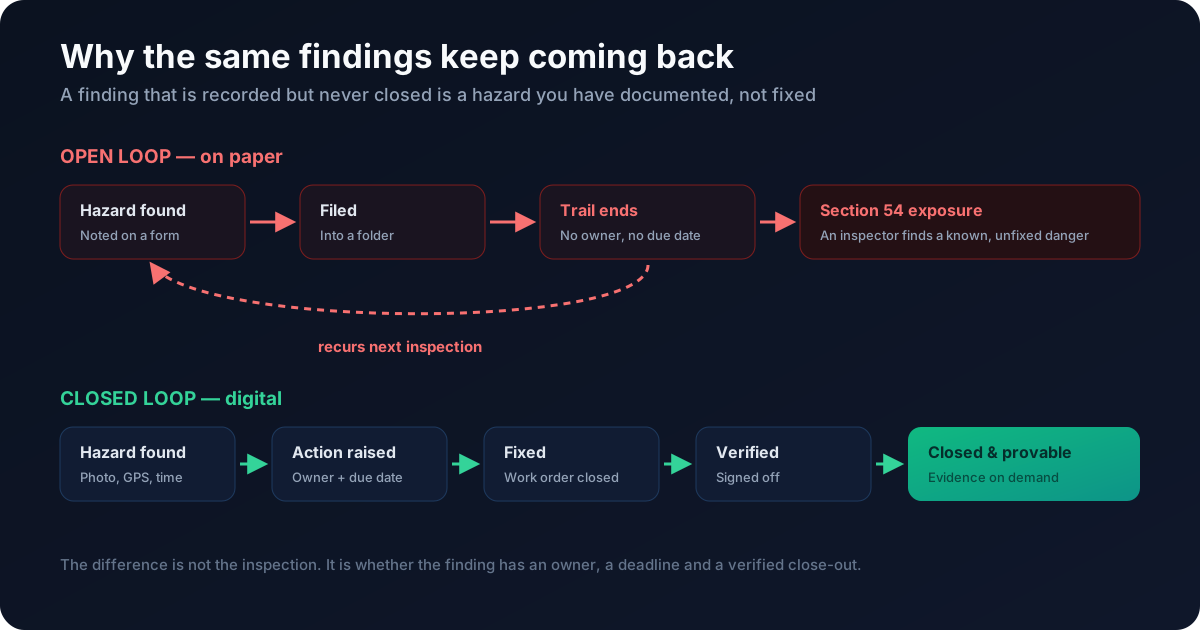
Paper does not fail because it is old-fashioned. It fails because a finding written on a form has no owner, no deadline and no proof it was fixed. Here is what changes when the record becomes data.